Weeks 4 and 5 didn’t bring any lambs, which was expected. Harriet was bred successfully a couple weeks after all the other ewes.
May 4, 2025 – Sunday
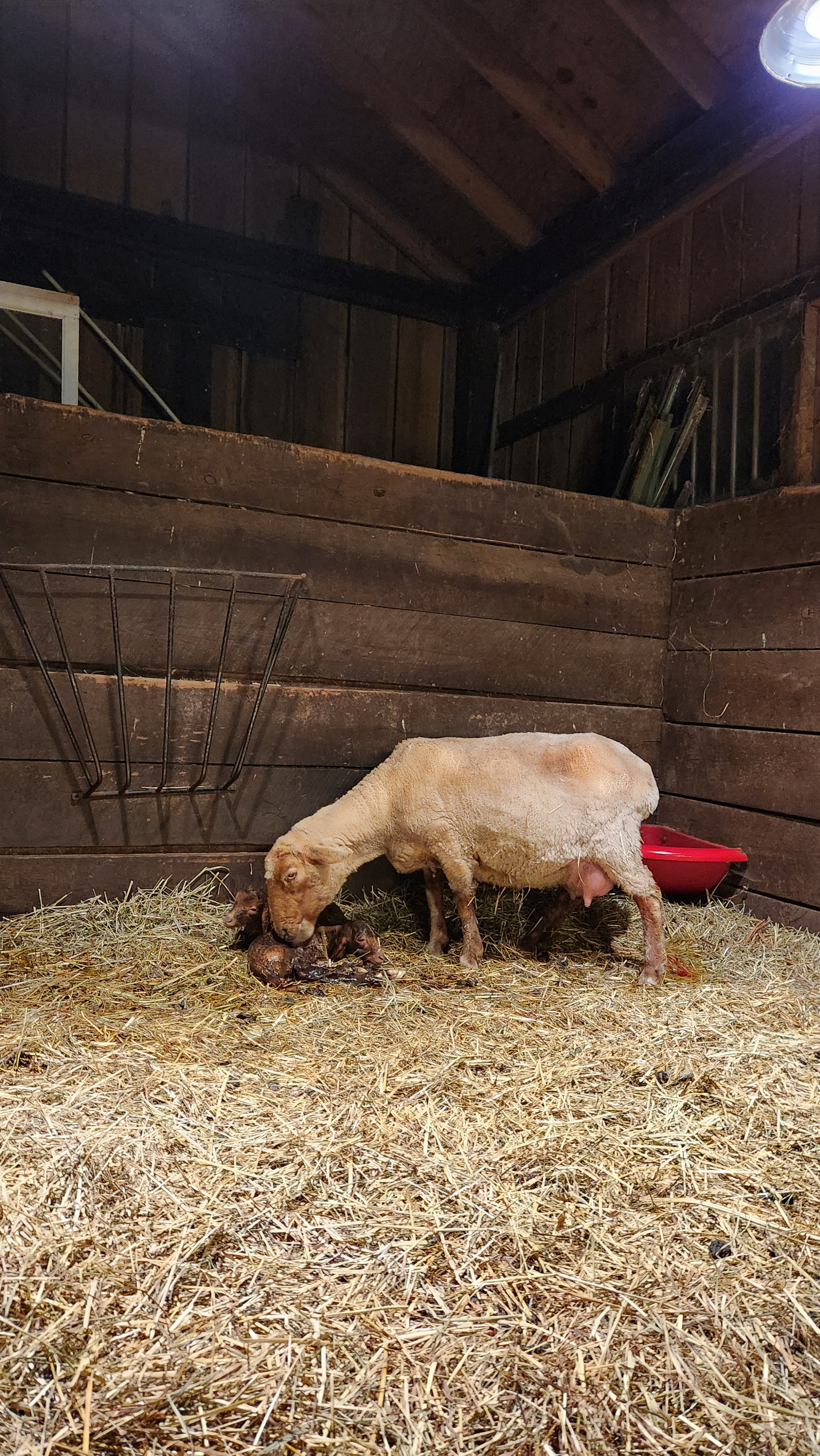
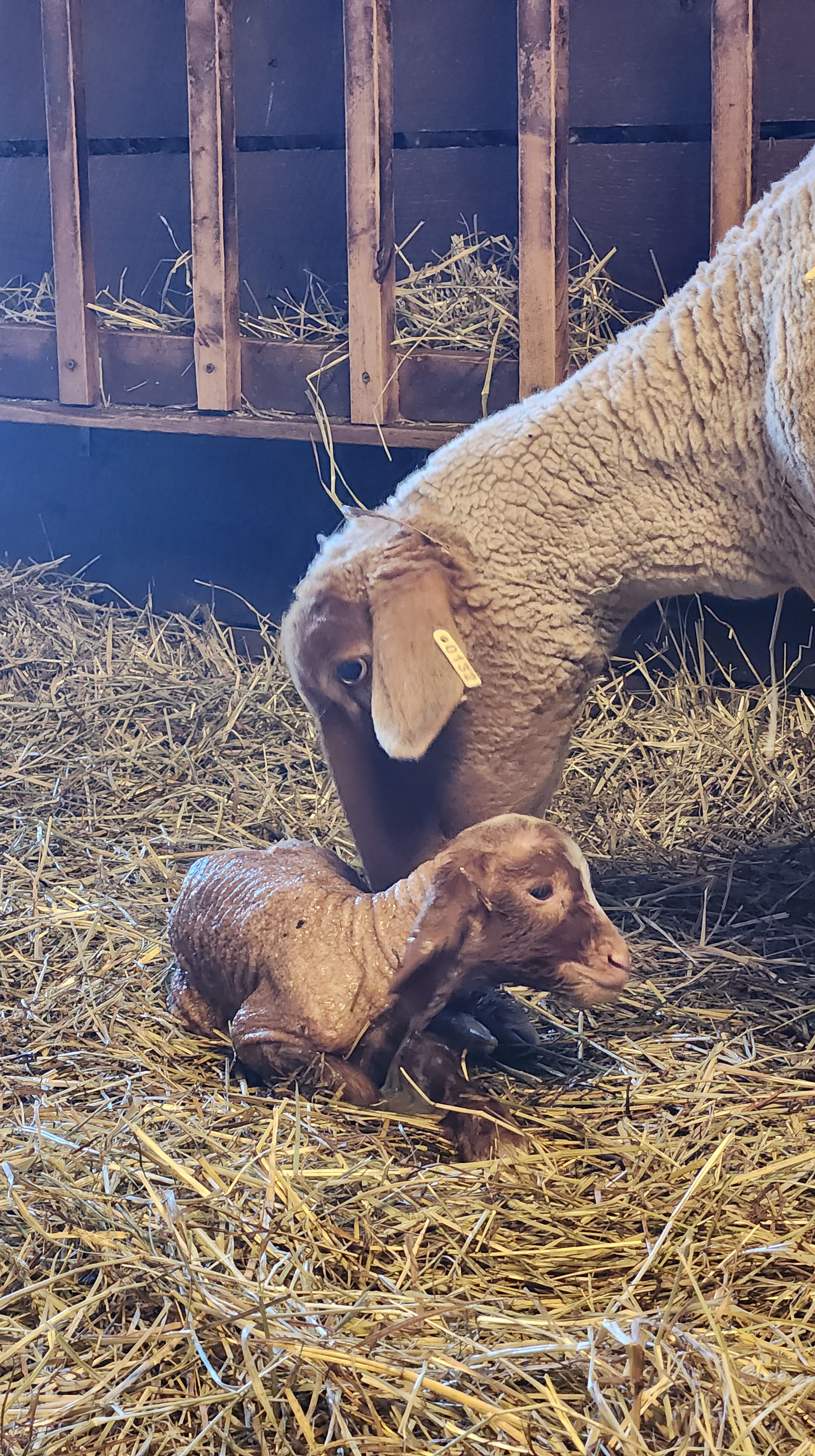
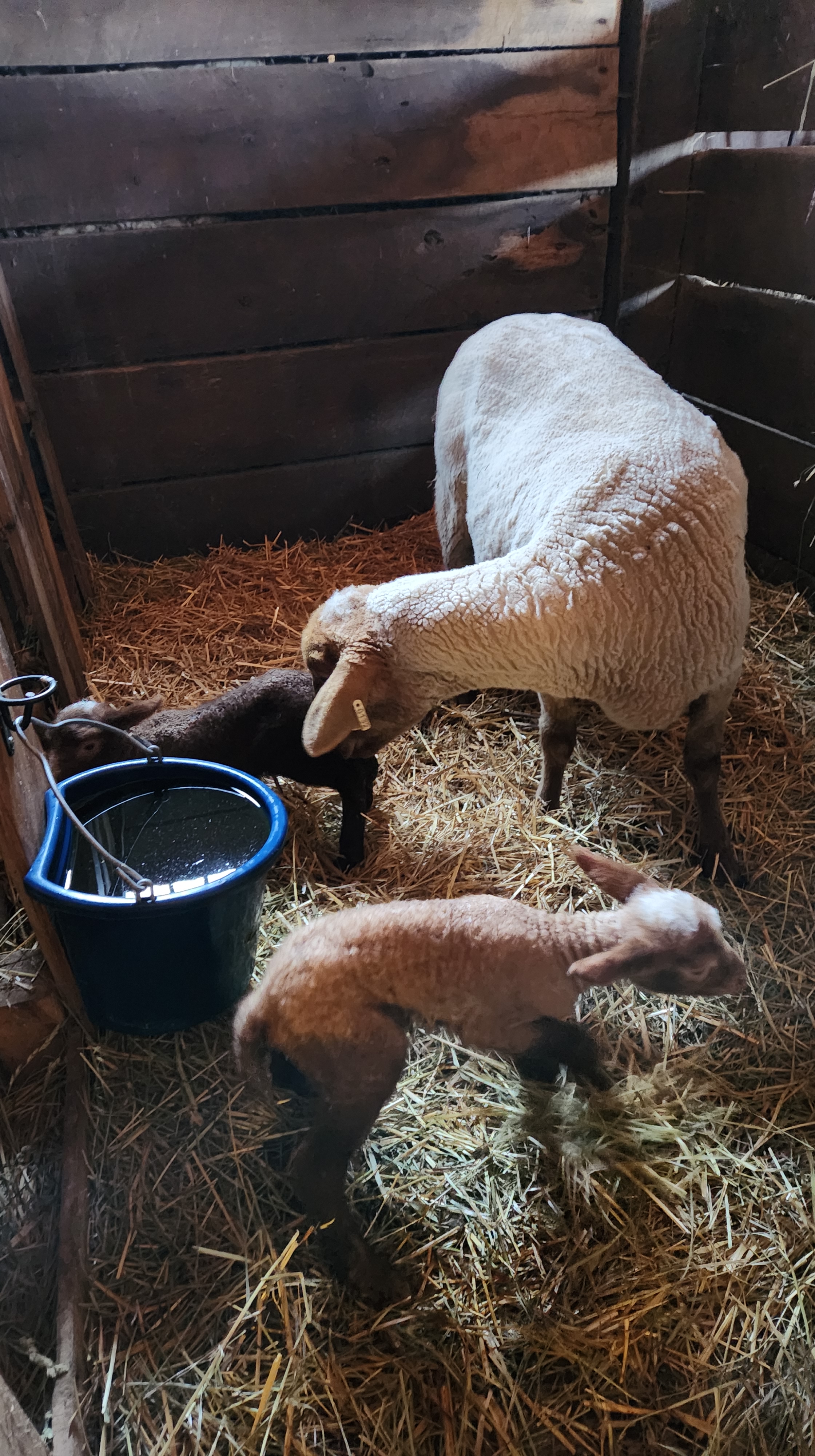
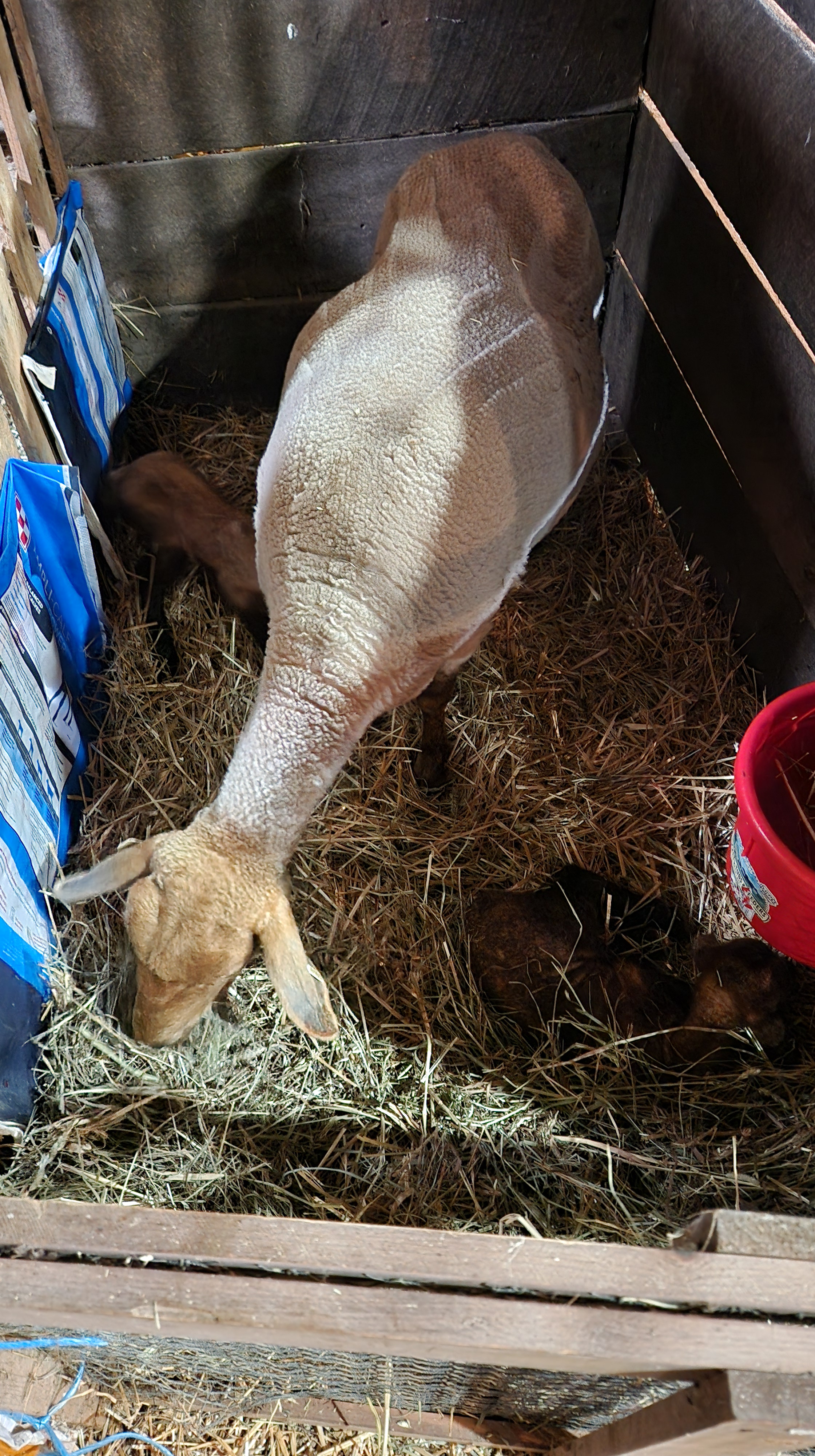
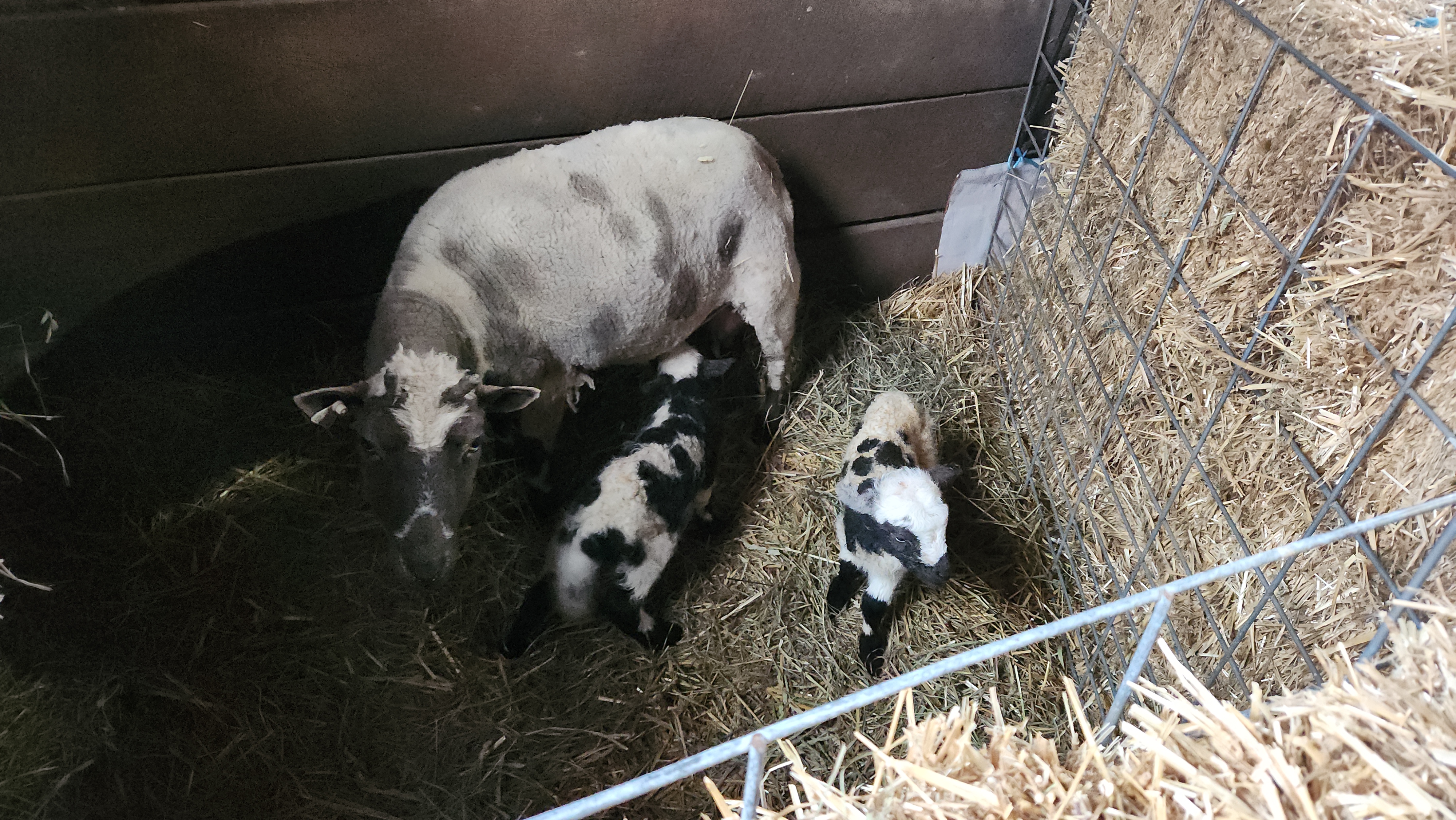
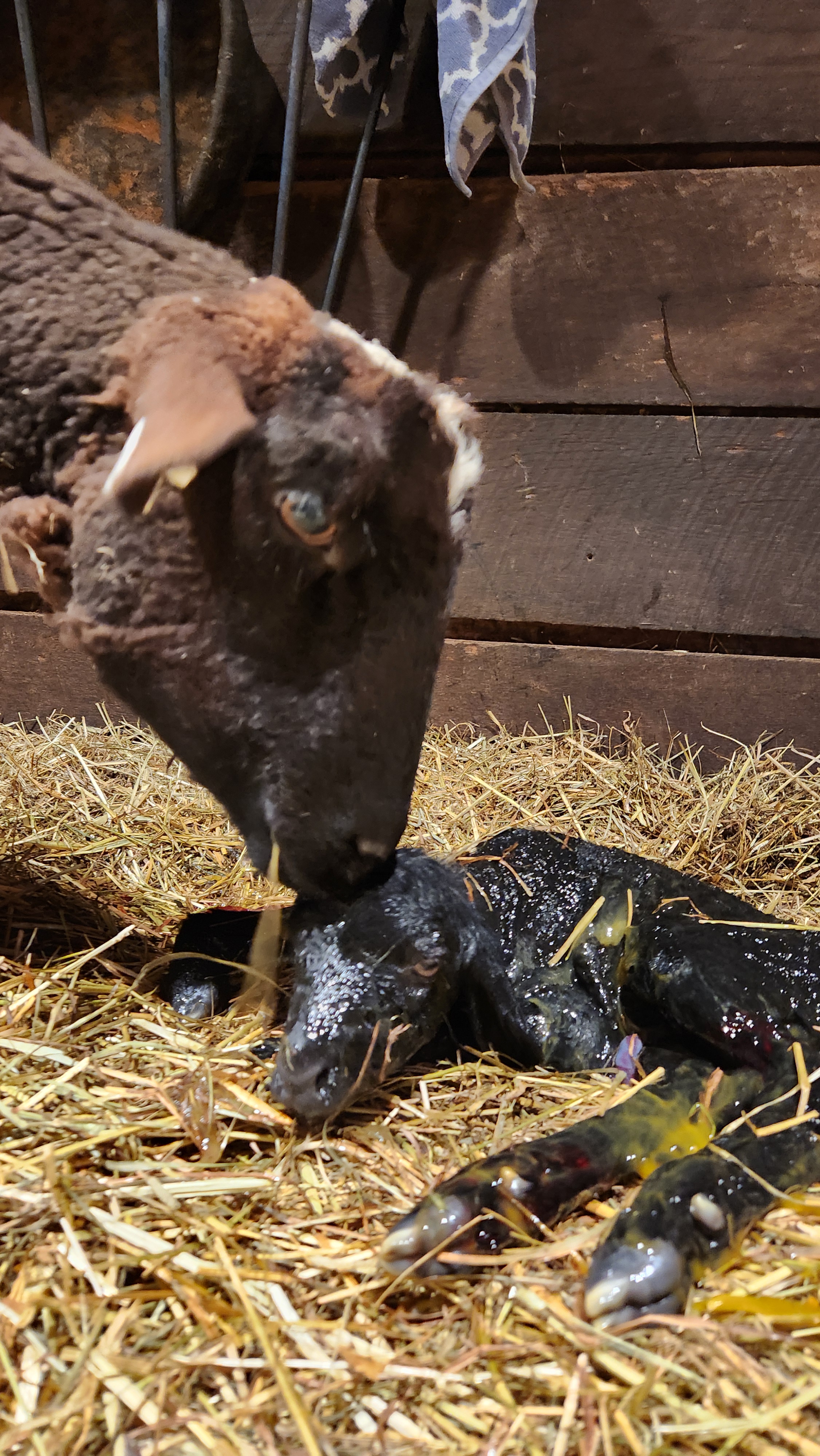
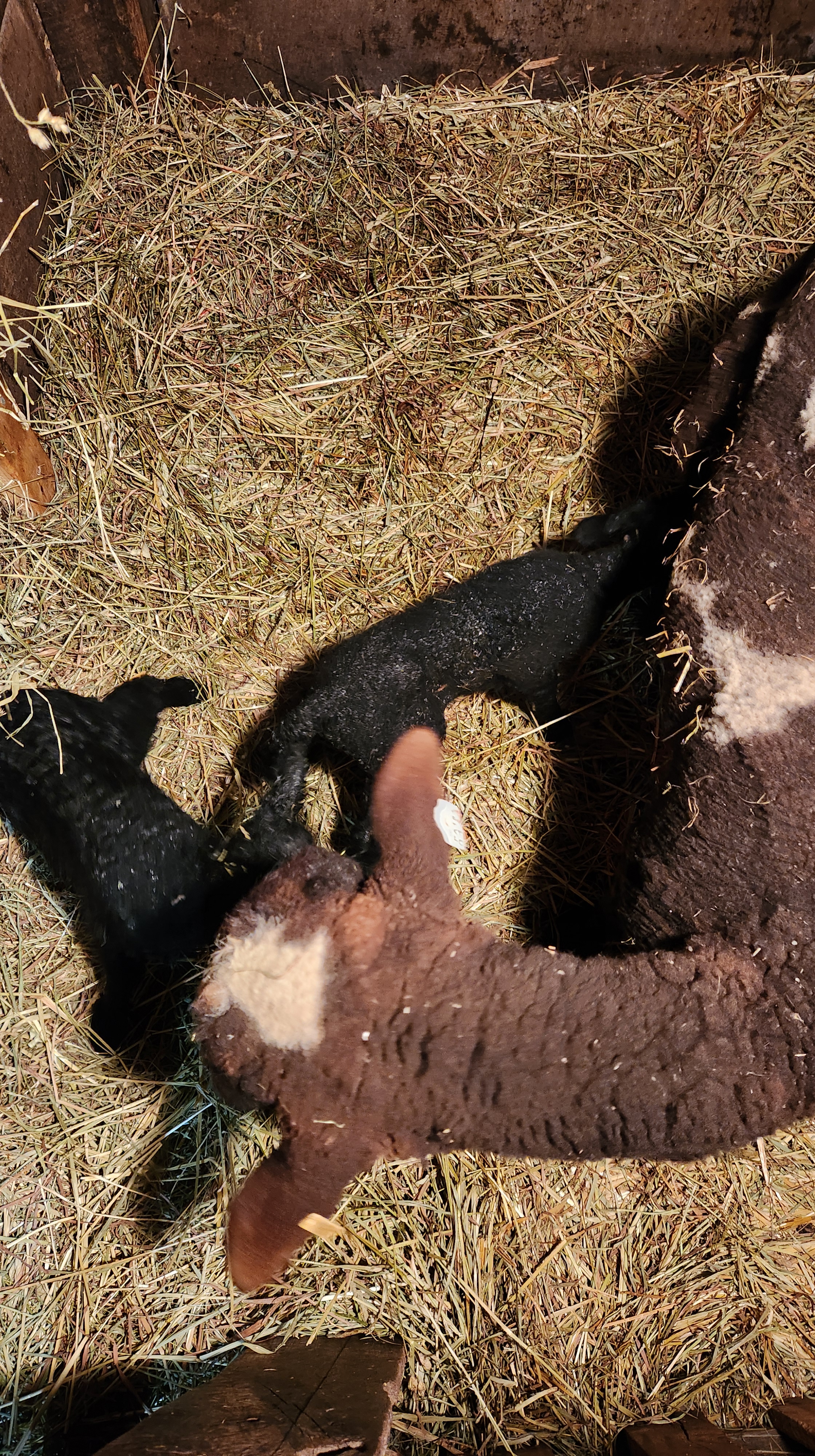
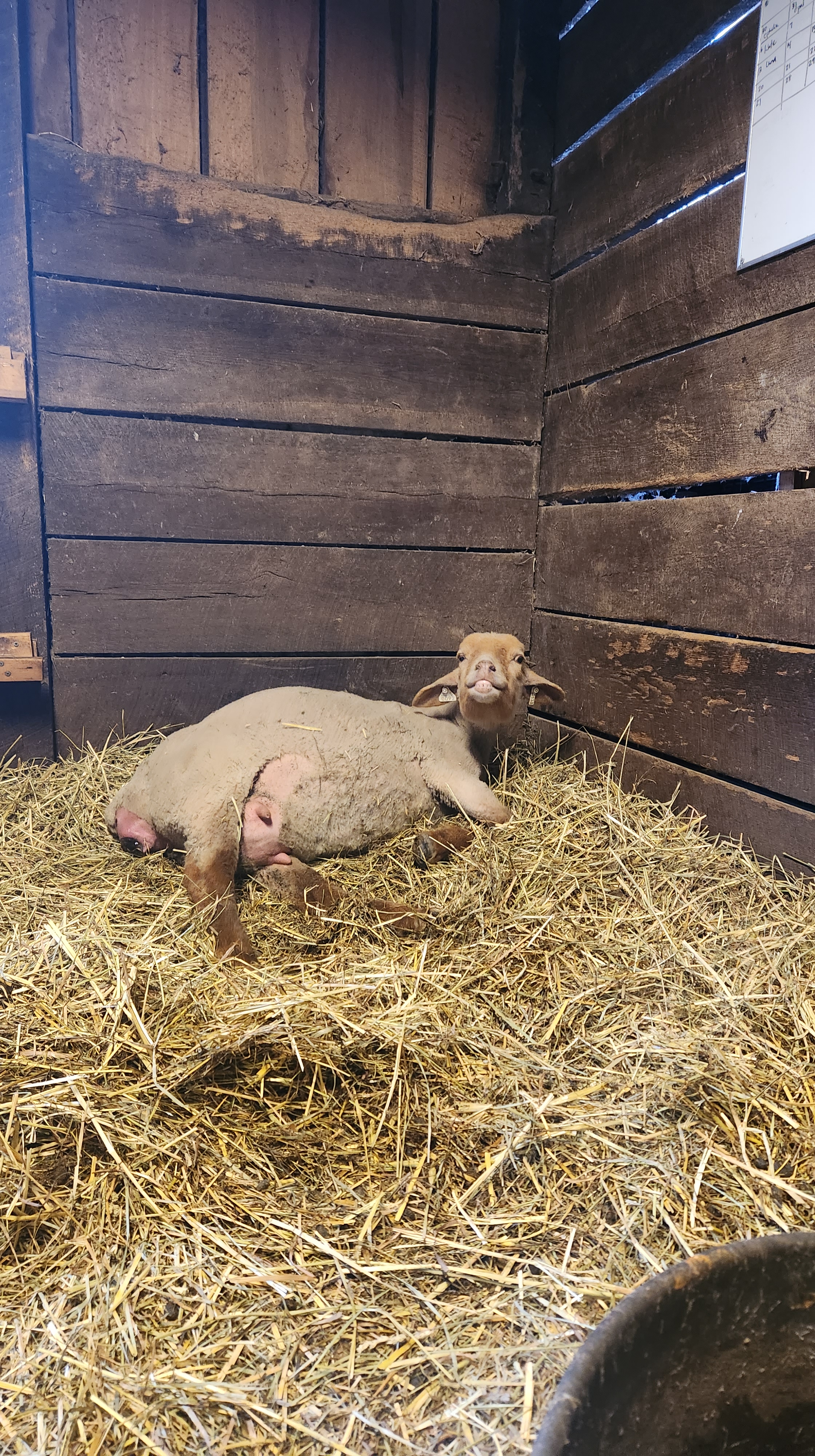
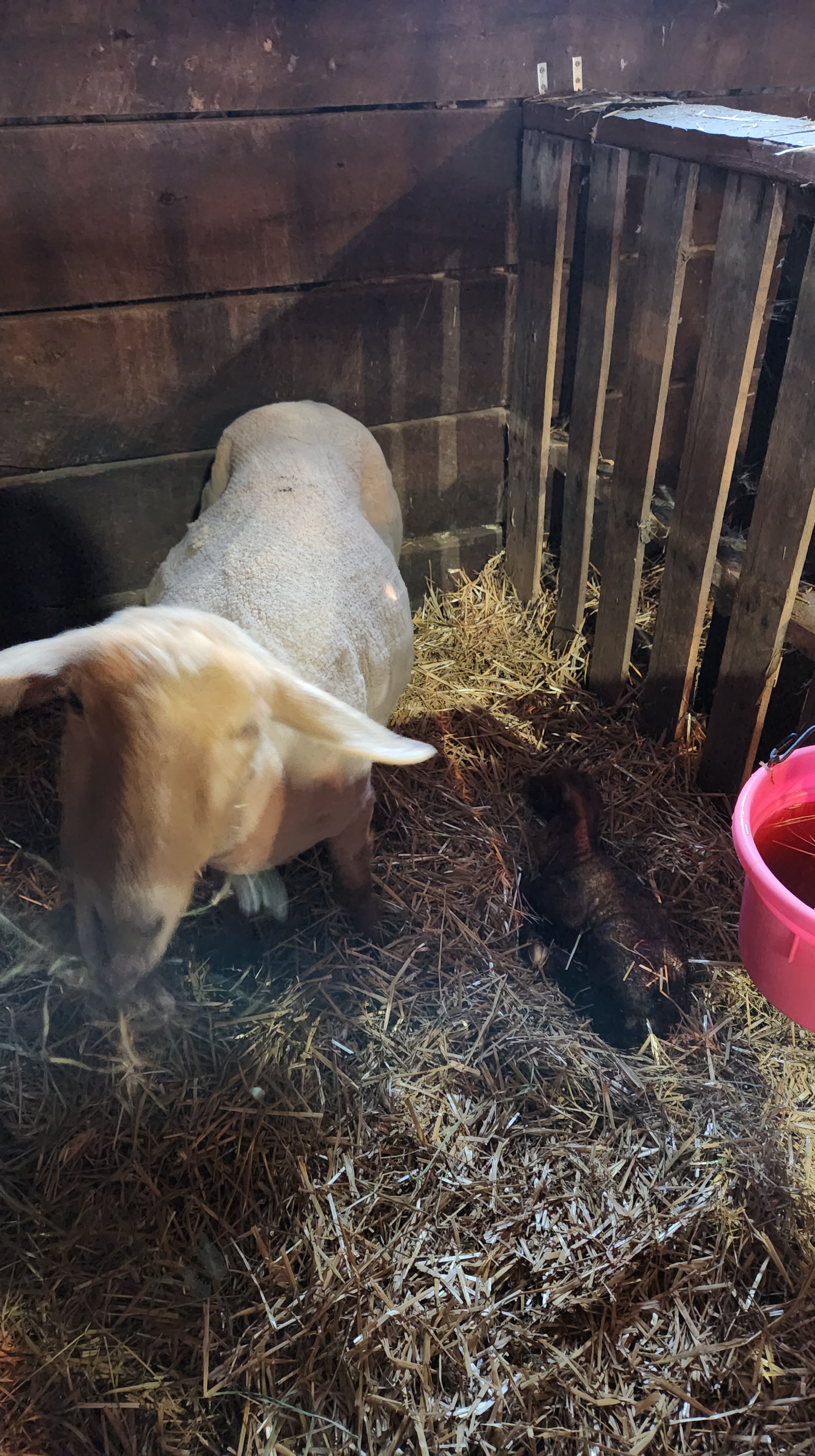
Harriet had twin ewe lambs around 4 this morning. She had us fooled, thinking she was going to have triplets! The 1st lamb weighed 8lbs, and the 2nd weighed 9lbs.
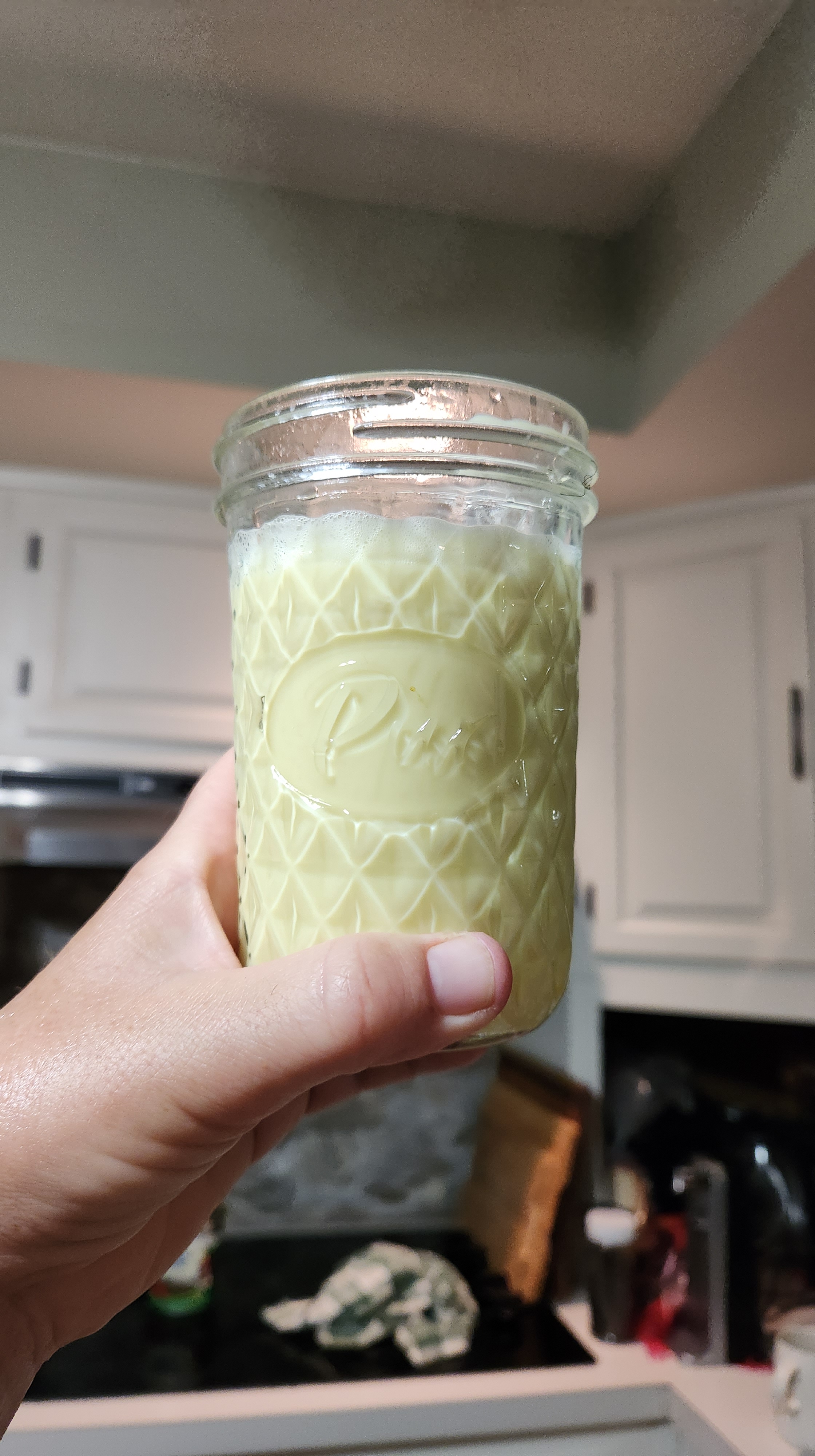
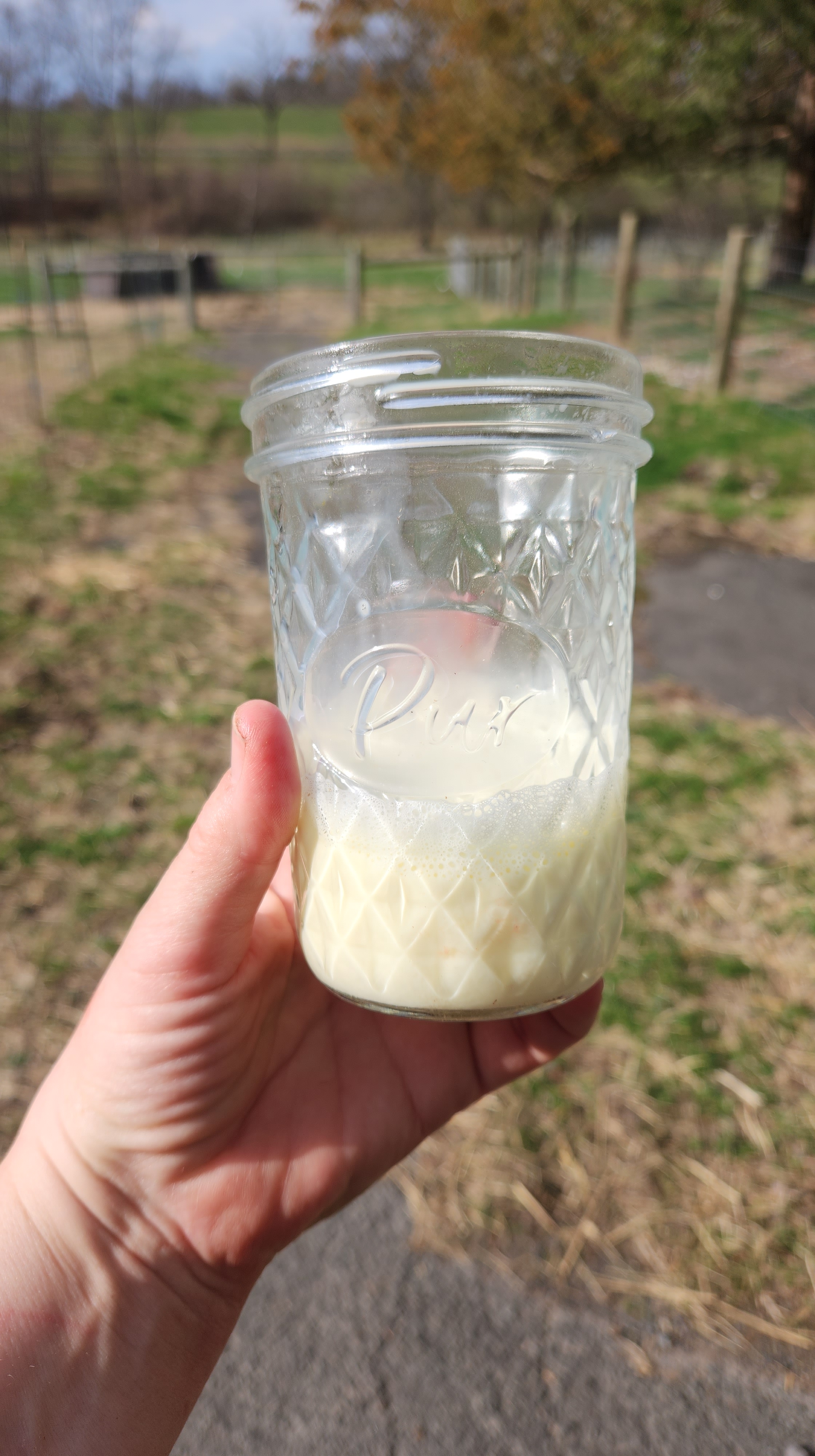
Harriet’s udder was so engorged that I milked out some colostrum so the lambs could latch on top her teats better. The colostrum will go into the freezer for any future emergencies.
That’s a wrap on our 2025 lambing season! We had 20 lambs. 9 sets of twins and 2 singles. 16 ewe lambs, 4 ram lambs. 11 Tunis, 3 Jacob, and 6 Tunis/Jacob cross.
I checked on her throughout the morning, and just before I ran to the feed store in the afternoon. By the time I got home from the feed store, she had delivered a ram lamb and was cleaning him.
After a few minutes, she began pushing again and delivered a ewe lamb. Once they were both standing and walking, I made sure they nursed before moving them to the lambing jug.
The ram lamb weighed 8.55lbs and the ewe lamb weighed 8.1lbs.
April 11, 2025 – Friday
Maya had a 10.65lb ewe lamb just before 5am this morning!
I remember waking up around 3 or 4am to check on the monitor only to see Maya laying contentedly in the stall. The next thing I know I was waking up at almost 5am to her baaing to a lamb.
I didn’t check yet to see how many horns she has or if she’s lilac or black and white. Maya is a very protective mama and was upset enough by me weighing her lamb.
We let Kate and her lambs out of the jug and put Maya and her baby in, so there was a bit of confusion for a couple minutes until everyone settled down.
Edit: the ewe lamb is a 2-horn dark lilac lamb.
April 11, 2025 – Friday
Luna totally surprised us this afternoon with twins ewe lambs! She wasn’t due till Sunday and she didn’t look ready to lamb at feeding this morning, so I wasn’t checking the monitor very often today.
I was packing up Etsy orders and watching the livestream of Noah’s baseball game this afternoon, and all the sudden I heard what sounded like newborn lamb cries so I rushed out onto the deck. Luna was out in the barnyard with 2 brand-new, almost dry lambs. One lamb was 7.85lbs and the second was 7.2lbs.
Harriet is our last pregnant ewe and she’s due around May 1st.
Check back in early May for our final entry for this year’s Lambing Diaries!
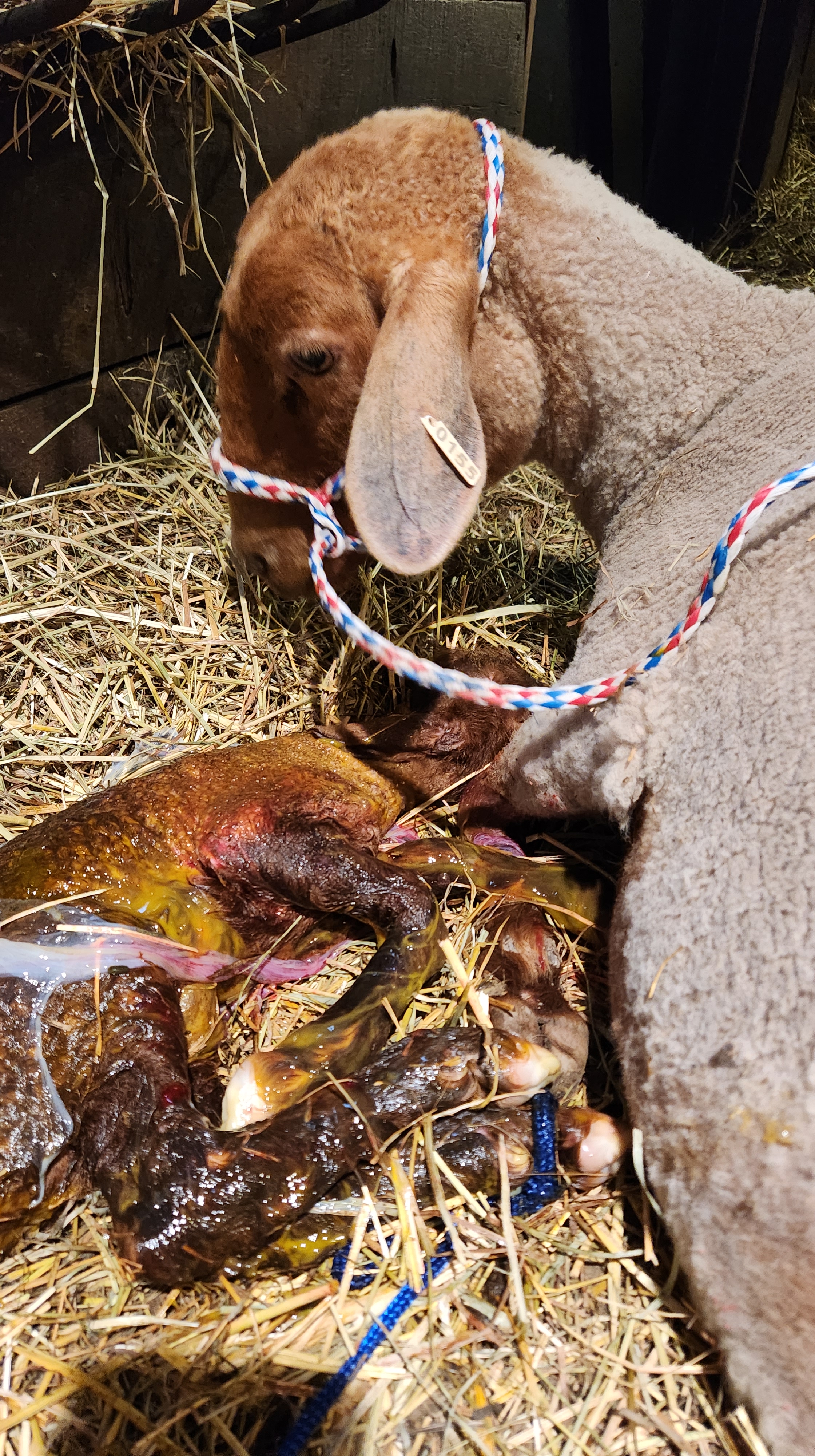
I noticed Prim seemed to be in early labor around noon so I kept an eye on her to watch her progress. Some pushing by 1pm but no water sac. I did a quick examination and felt the sac. Prim is more nervous about being touched while in labor so I had to halter and tie her.
After a while I decided to give her space and watch her from the kitchen window, hoping that would help her labor progress, but it didn’t. She didn’t want to go back into the barn so I lured all the mamas in with some grain.
Once haltered again I examined her again and felt a little tail. Dave held her still(ish) for me while I found the back feet and repositioned the legs so I could pull the lamb out back feet first. After pulling the ewe lamb with my lamb puller, I checked for another. I felt a head so I let Prim rest and clean the 1st lamb for a few minutes.
The 2nd lamb emerged head first, but I was able to get 1 front leg repositioned easily to help pull it out. The lamb was limp when I got her out but began to breathe and move once I pulled the sac from her face.
The 1st ewe lamb weighed 8.65lbs and the second ewe lamb weighed 7.85lbs.
Once both lambs nursed, I milked out some colostrum to freeze for any future emergencies.
April 5, 2025 – Saturday
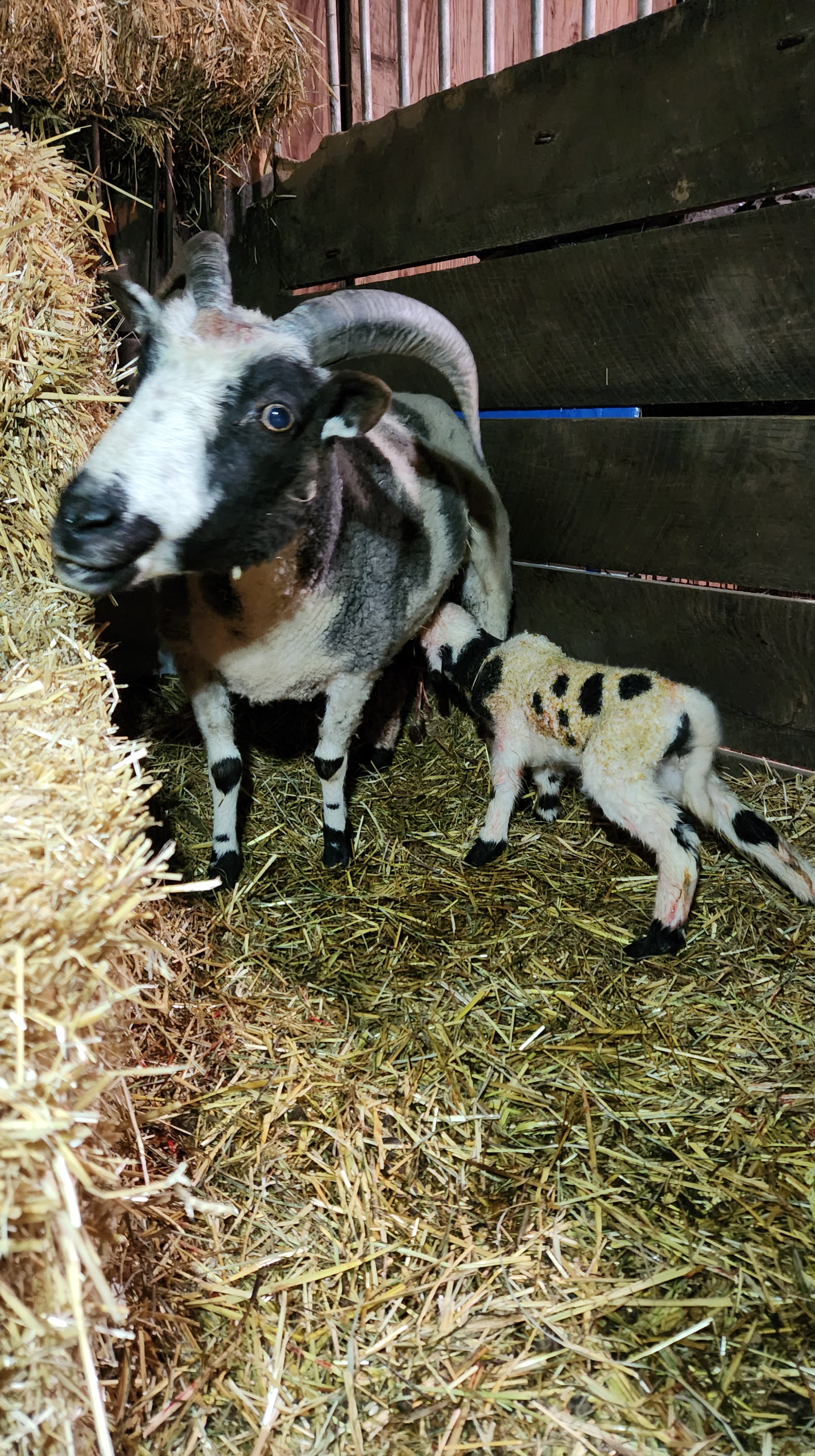
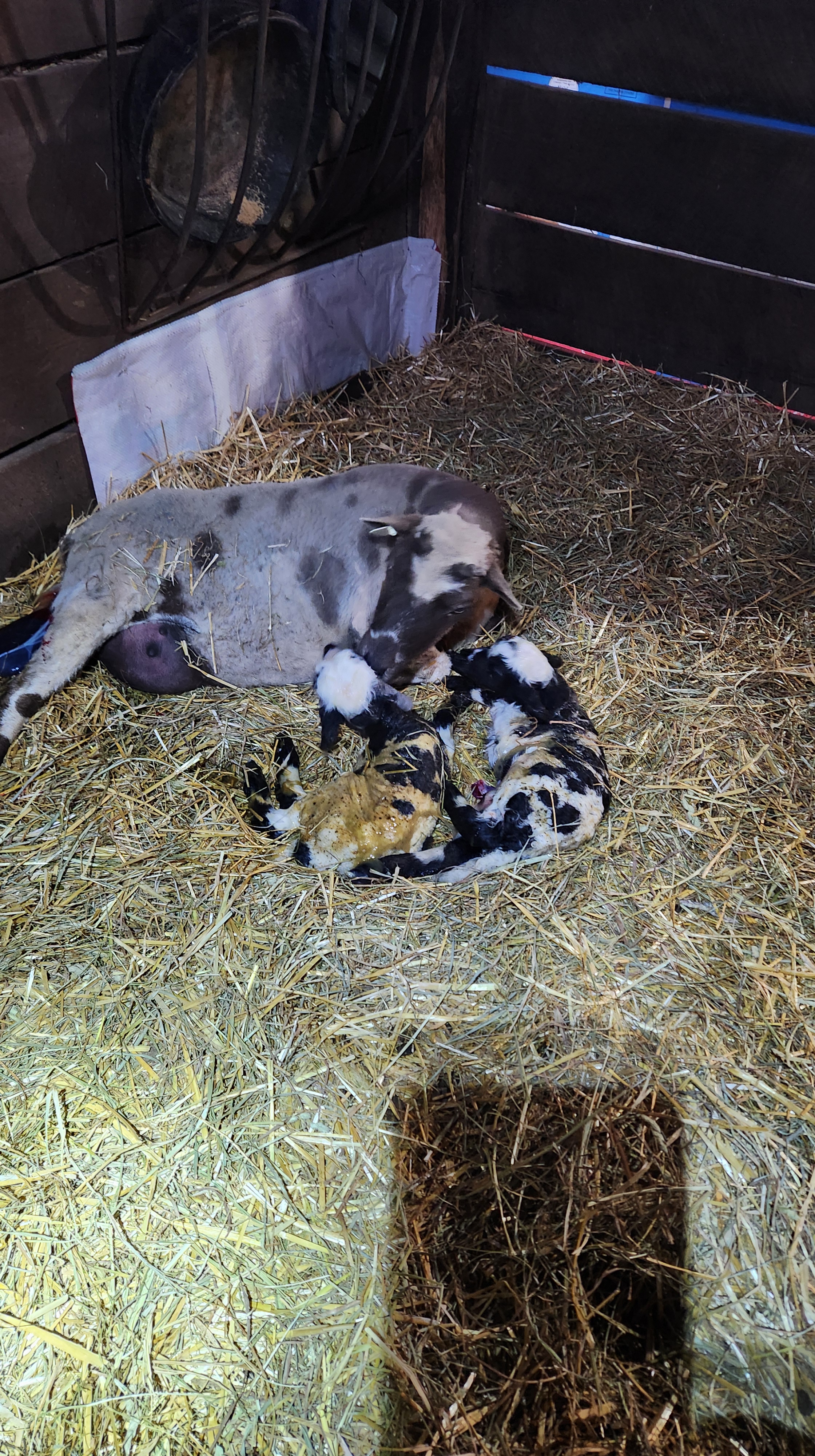
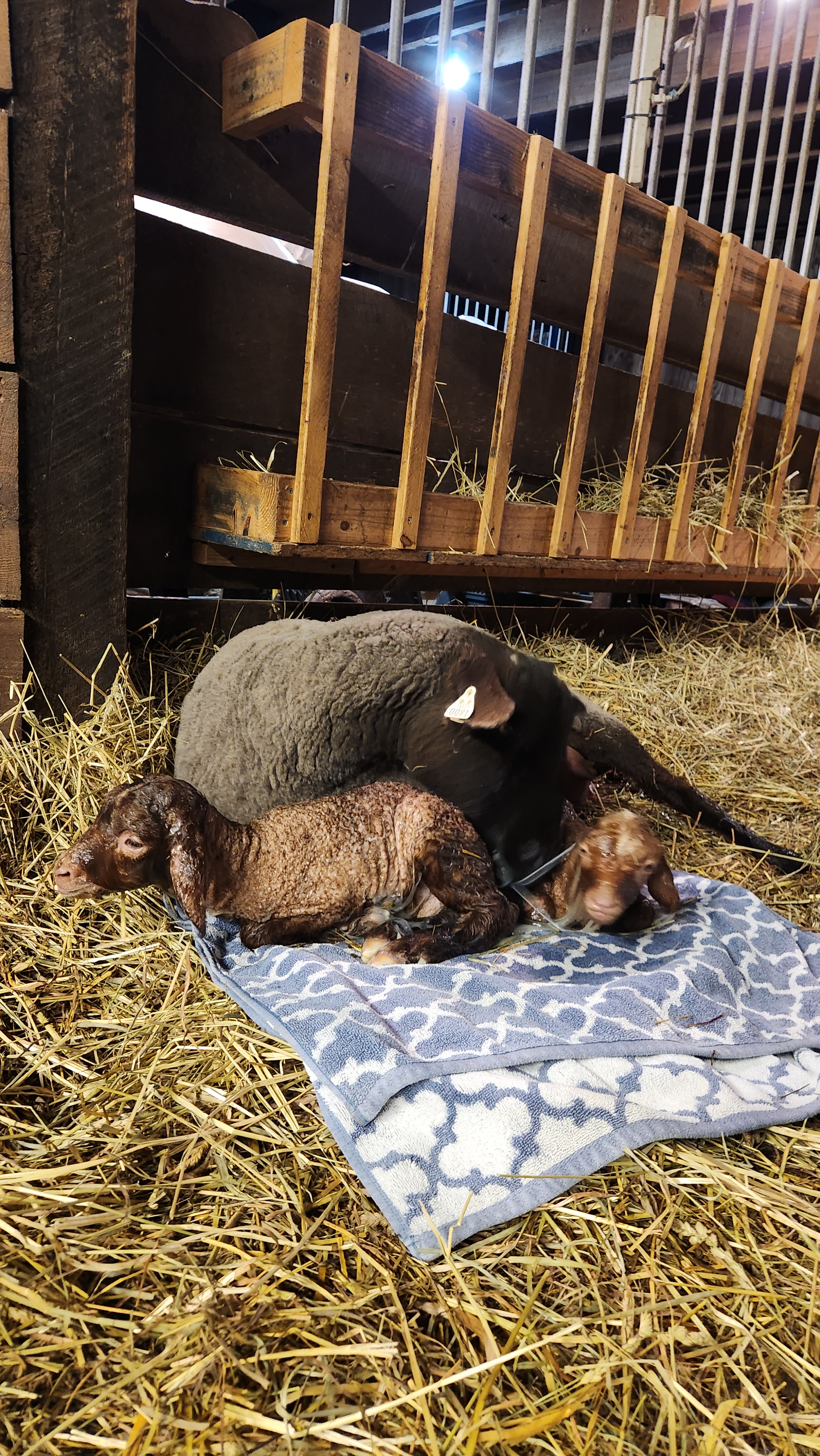
Kate had twin ewe lambs this morning! She didn’t want to eat breakfast around 8sm, so I went out to the barn to check on her. Maya kept bothering her, so we opened the stall door and let her wander around the barn aisle.
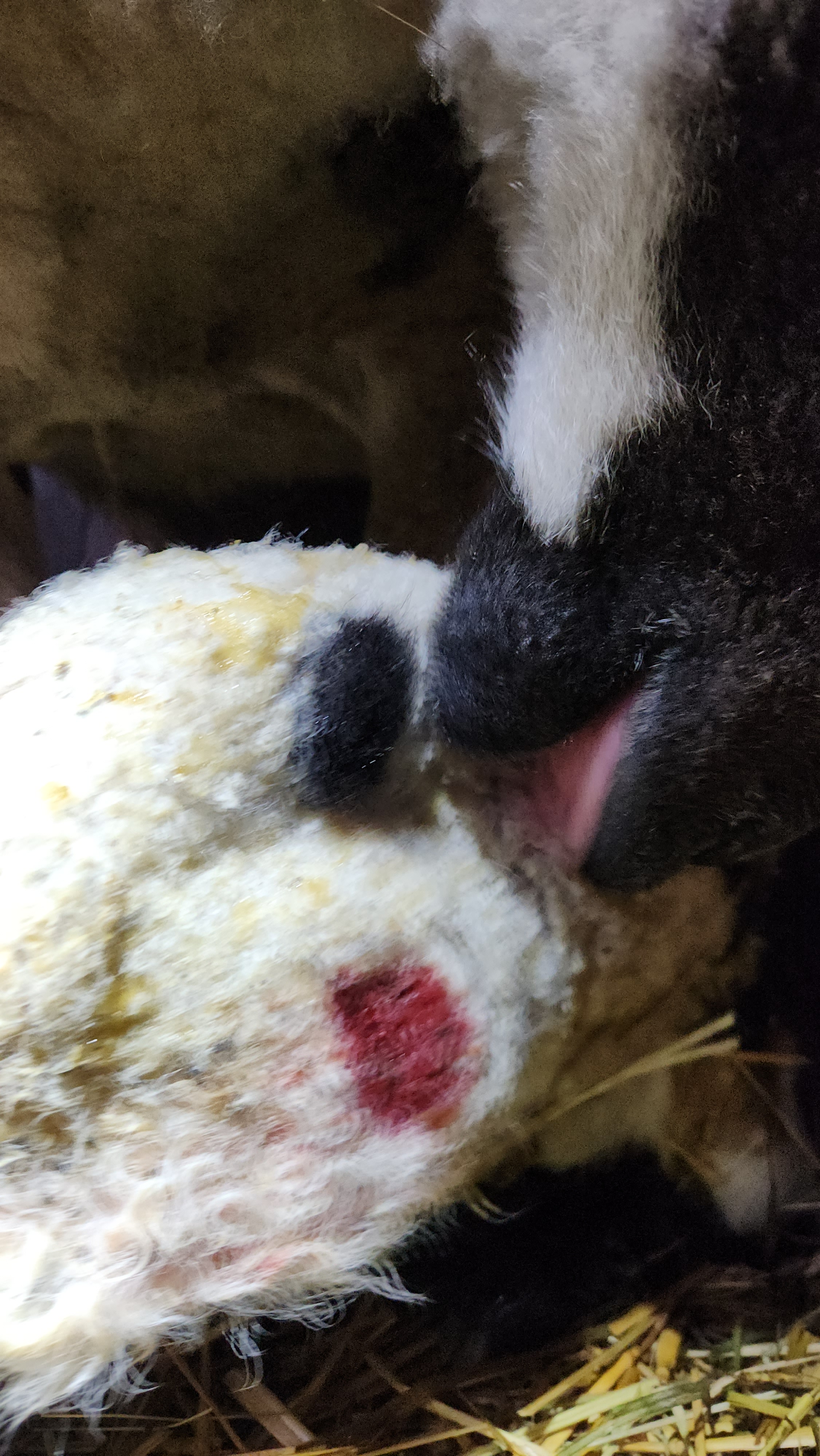
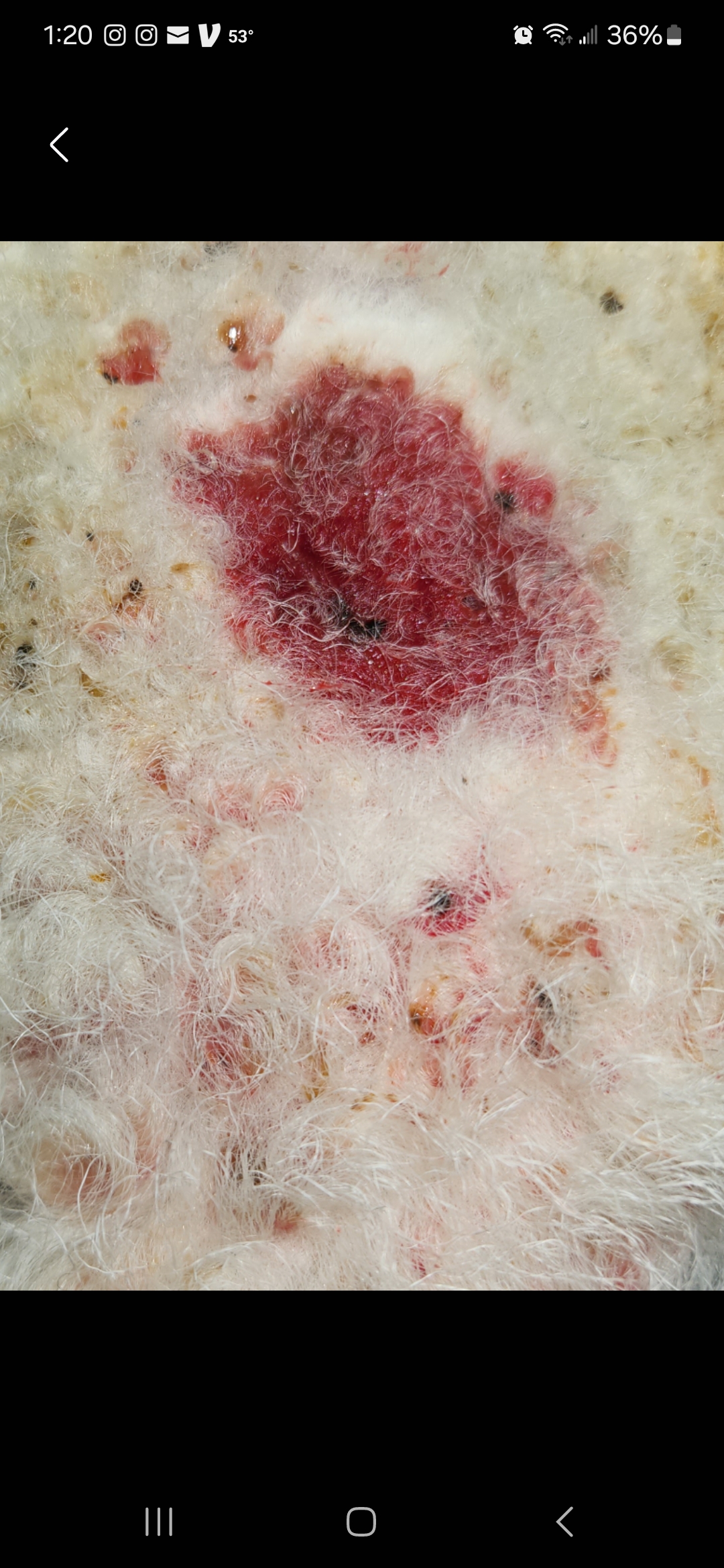
The first lamb was born around 10:30. She’s the one on the left in the 1st photo. She weighed 7.25lbs and has an odd spot on her right rear leg that looks like raw skin. I’m researching epitheliogenesis imperfecta, but I’m not sure if that’s what it is. I can’t tell if there’s actually no skin or just raw skin. It’s definitely in the shape of her other spots.
The second lamb was born shortly afterwards and weighs 8.4lbs. Both lambs seem to be lilac or dark lilac but we’ll be able to tell better as they get dried and cleaned. I think 1 is a 4 horn and 1 is a 2 horn.
We added a wall of straw around the lambing jug because Maya tried multiple times to clean the lambs through the panels.
Edit: I applied a medicated cream to the first lamb’s red spot after she was clean and dry. even though it seemed like it wasn’t raw skin anymore. After a day or so, you could barely see where the spot was, and now the area looks and feels normal. I’m wondering if a blood clot or something got stuck in her fiber during or before birth.
April 8th
April 16th
April 6, 2025 – Sunday
Qi’ra surprised us with twins tonight! I thought she was too slender to be carrying twins, but she fooled me.
She showed us she was getting ready to give birth by separating herself from the other ewes most of the day. When I checked the monitor around 8pm or so, I saw her pushing. I went out to the barn and watched her for a while. When it was obvious she was tiring, I helped her deliver the lamb. She’s a first-time mama and wasn’t sure what was happening most of the delivery, but once the lamb made noise, she began cleaning it off.
We moved her and the ram lamb to the lambing jug, and I noticed she had another set of hooves visible. Her first lamb was up and nursing, and Qi’ra wasn’t pushing the second lamb out. I wiggled the feet around, and she soon delivered the ewe lamb.
The ram ram weighed 9.65lbs, and the ewe weighed 8.05lbs. They had so much energy that once they got their footing, they didn’t stop moving.
For a first-time mama, Qi’ra is pretty relaxed and is taking good care of her babies.
Odette kicked off lambing season today at dinnertime with an 8lb ewe lamb born butt-first. I found her mid-labor and was hesitant to check the position of the lamb because I thought she was still in early labor.
After about 30-45 minutes went by with no water sac emerging, I prepared to check on the lamb’s position. As Odette pushed, the lamb’s butt became visible and I knew at this point repositioning the lamb would be difficult. I wiggled the lamb’s hips with the next contraction and was able to deliver the hips and rear legs. I pulled the rest of the lamb quickly before she could start to breathe while still in the amniotic fluid. She was limp for a few seconds, but after I got her airways clear, rubbed her chest, and Odette started cleaning her, she started to breathe.
March 27, 2025 – Thursday
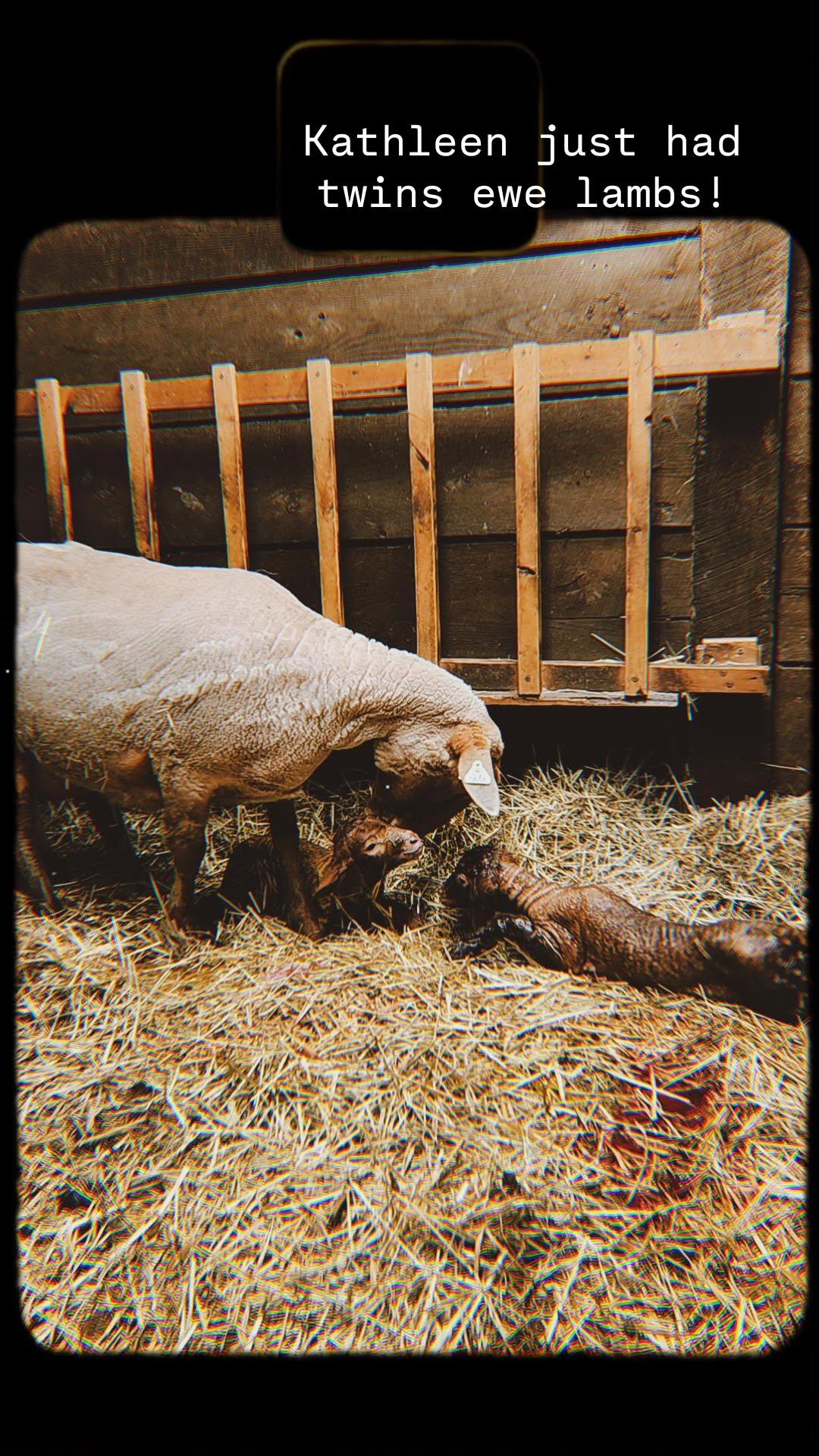
Kathleen had twins ewe lambs just before 3am. The first was 9.3lbs and the second was 9.4lbs.
I noticed her acting like she was close to labor around 7pm last night and checked on her every hour or 2. I decided to go to the barn around 2am because she was pushing but not progressing. After a quick internal, I determined the lamb’s presentation was good but she was probably just big. Fast forward a bit and the water sac emerged along with feet and a nose. Several minutes after the first lamb was born, Kathleen delivered a second, also normal presentation.
Mama and lambs are in the lambing jug now and both lambs have nursed. Kathleen enjoyed some warm water with molasses, a little grain and has lots of hay to eat while her lambs nap.
March 30, 2025 – Sunday
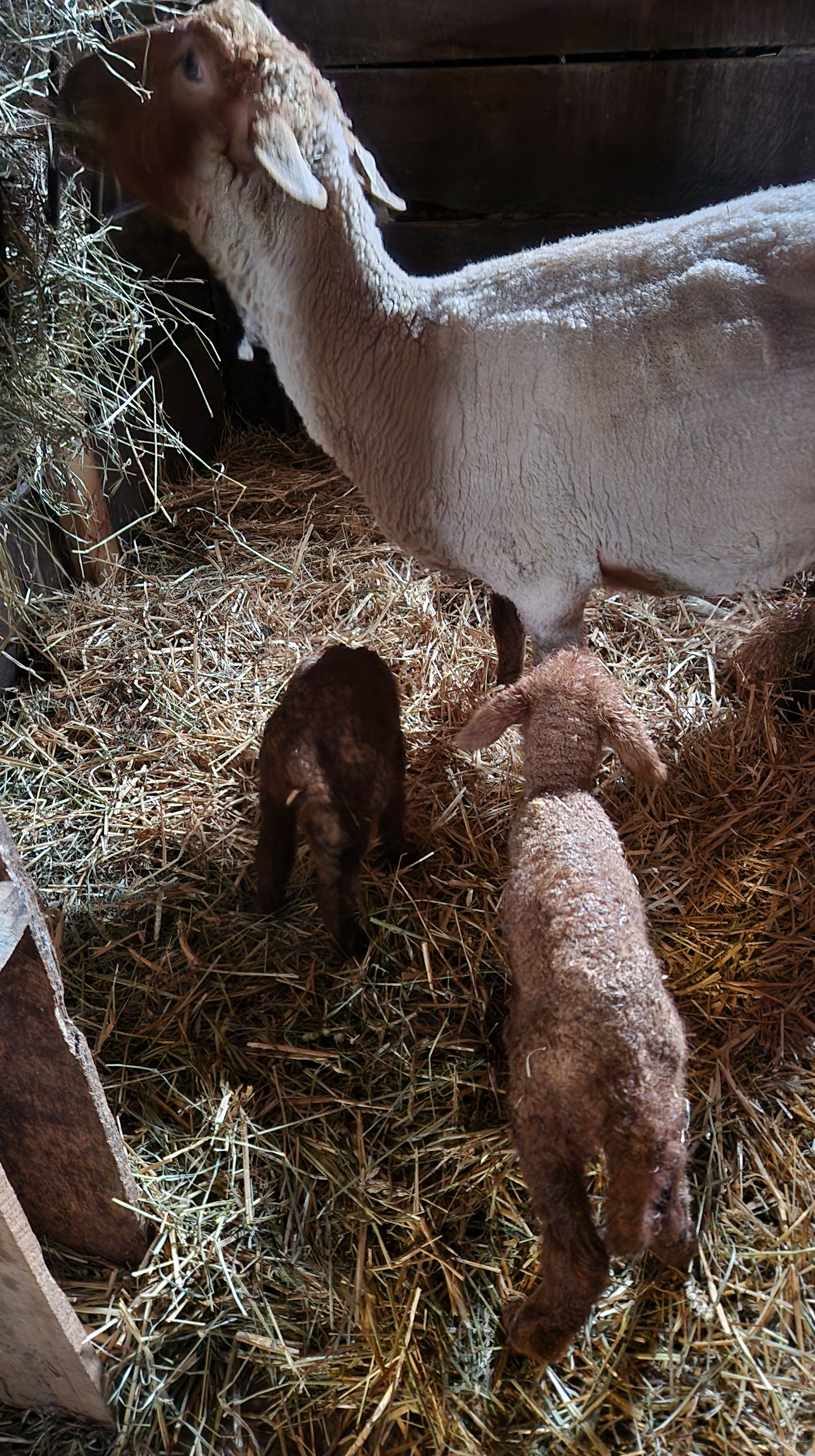
We woke up to twins from Ophelia, all dried, nursed and happy. The brown lamb is a ewe and is 7.35lbs. The black lamb is a ram and is 7.25lbs.
March 30, 2025 – Sunday
A ram and a ewe for Opal!
I checked on the monitor before I went to bed and saw she was in labor, so I headed out to the barn. The ram was born first and is 8lbs. The ewe was born very soon after the ram and is 6lbs.
Both are up and have nursed, and I’m going to bed.
The lambs’ first time outside is always exciting as they explore their new surrounding and really stretch their legs.
The lambs love racing around the fields in the evenings, especially when they’re little. It’s always fun to watch them run and bounce through the pasture.
It’s nearly time to wean the lambs from their mamas and the have grown so much over the past 3 months!
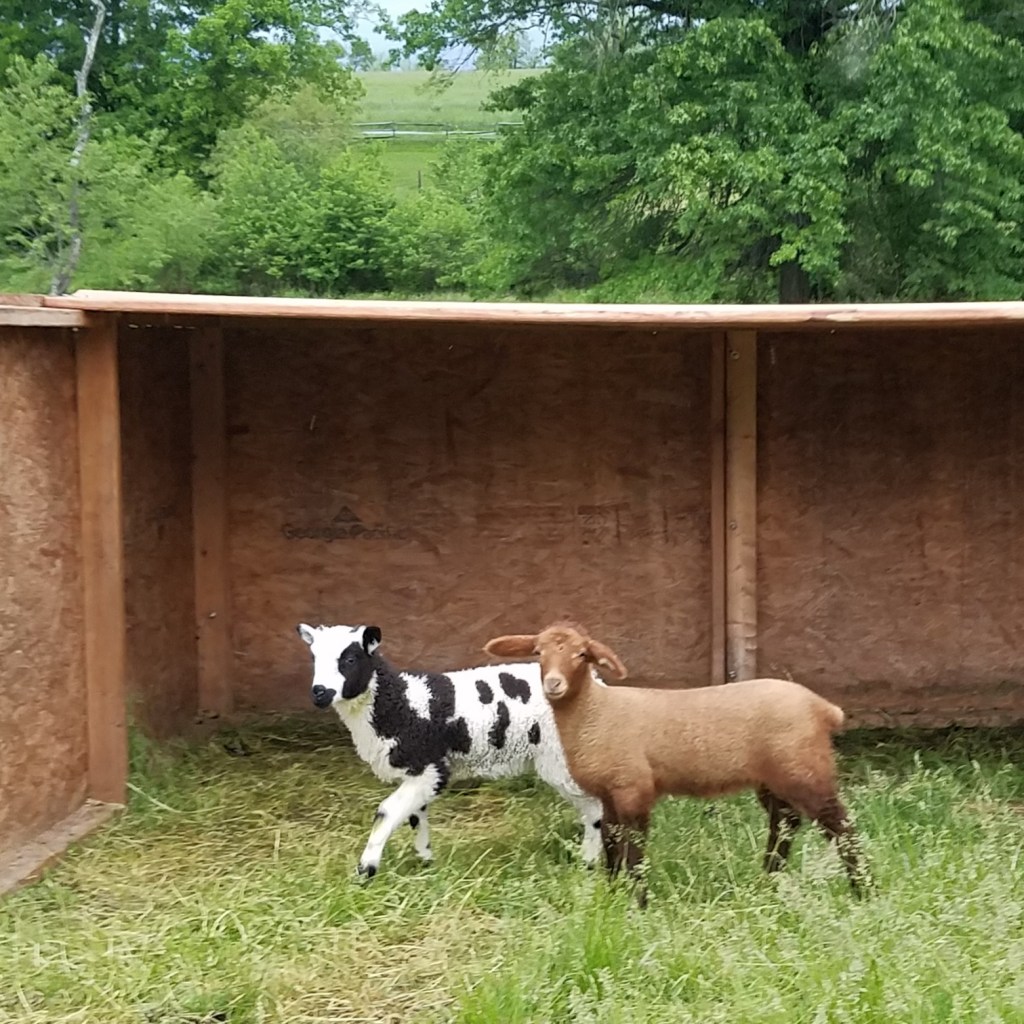
This is the end of May and the lambs are 3-8 weeks old.
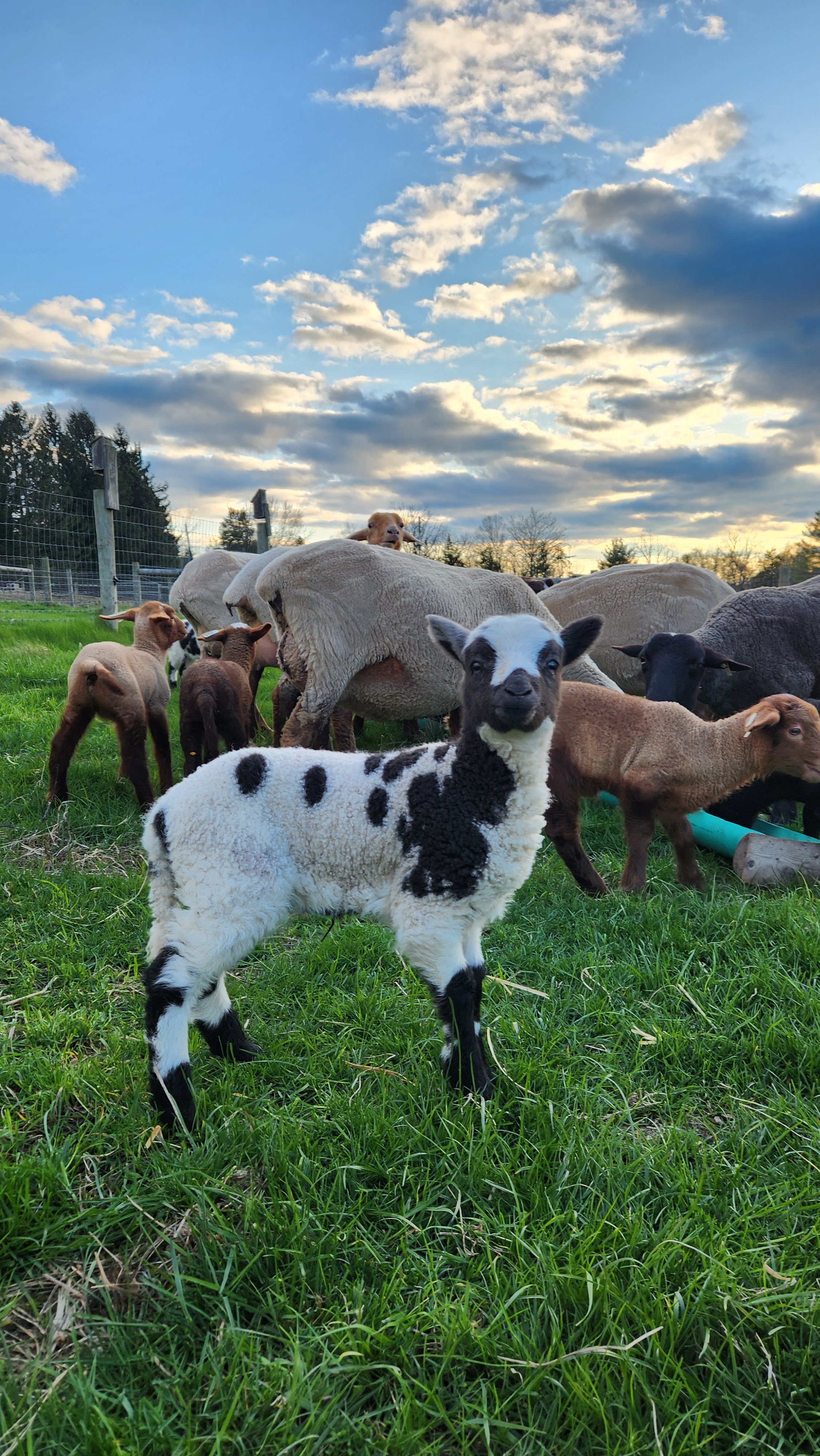
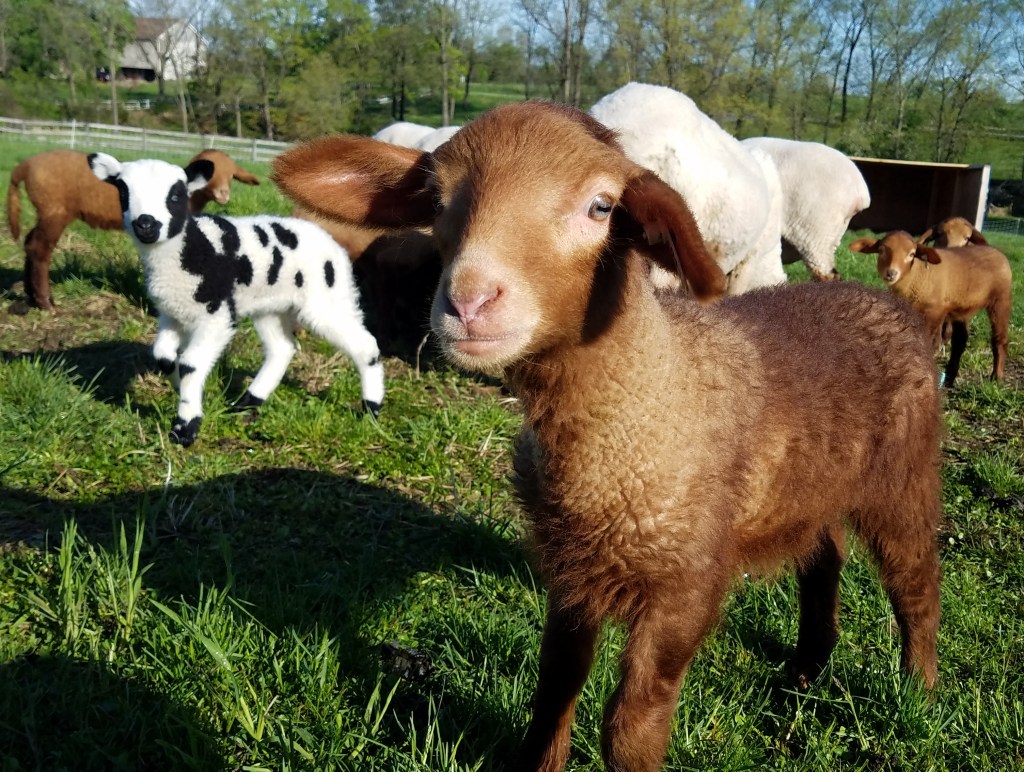
Here are the lambs a week later. Maya (the Jacob lamb) is 3 weeks old and her horns are peeking through her hair.
Maya is 5 weeks here, and Maggie is 2.5 weeks old.
The mamas and lambs are loving the green pastures, and hang out in the shade during the hottest parts of the days.
The first day of Spring brought us a 4th Nor’easter in 3 weeks. We avoided much of the heavy snow for the first 3 storms, but this last storm delivered a foot of snow. The big, fluffy flakes were beautiful falling from the sky.
And the trees remind you of Narnia, with their branches covered in snow.
But where was this all winter? I love snowstorms and have waiting for this kind of snow every time the forecast hinted at snow. It is quiet during a snowstorm and everything is blanketed in white, clean and sparkling.
It is nearly April, though, and this snow will not be here long. Soon we will be tucking seeds into the gradually warming soil of our gardens and waiting for tiny plants to emerge from the ground. Birds will hunt for insects and bees will search for nectar and pollen.
I wanted to put together a post of odd eggs that we have gotten over the years. To understand why mishaps occur in the egg laying process, though, you should first know how normal eggs are laid.
If you have a rooster in your flock, chances are most or all of your hens will lay fertilized eggs (eggs that will produce chicks if properly incubated). Each egg takes 24-36 hours to form. After the yolk is released from the ovary it travels through the oviduct. It is fertilized in the Infundibulum, the albumen (or the egg white) is added in the Magnum, the shell membrane is added in the Isthmus, the shell is added in the Uterus or Shell Gland, and the bloom is added in the Vagina. Most of this is self-explanatory, but many people have never heard of the egg’s bloom. This is a clear coating the egg is covered with to seal the pores so bacteria cannot enter the shell. Air, however, can still go through the pores. (This is why you can wipe off eggs to be incubated but you should never wash them.)
No Shell
Here’s an egg with only the inner membrane and no shell (also called a rubber egg). Hens can lay eggs like these at the beginning or end of their laying cycle or if they get scared (usually at night as a result of predators or stormy weather). You may see these eggs occasionally in your flock. If your hen lays eggs like this regularly, it may indicate a lack of calcium, phosphorus or salt in the hen’s diet; or an abnormality in the shell gland.
These eggs are normal in every other aspect and can be eated, but are usually torn open by the chicken (or the farmer). If left out too long they will start to dry out.
No Yolk
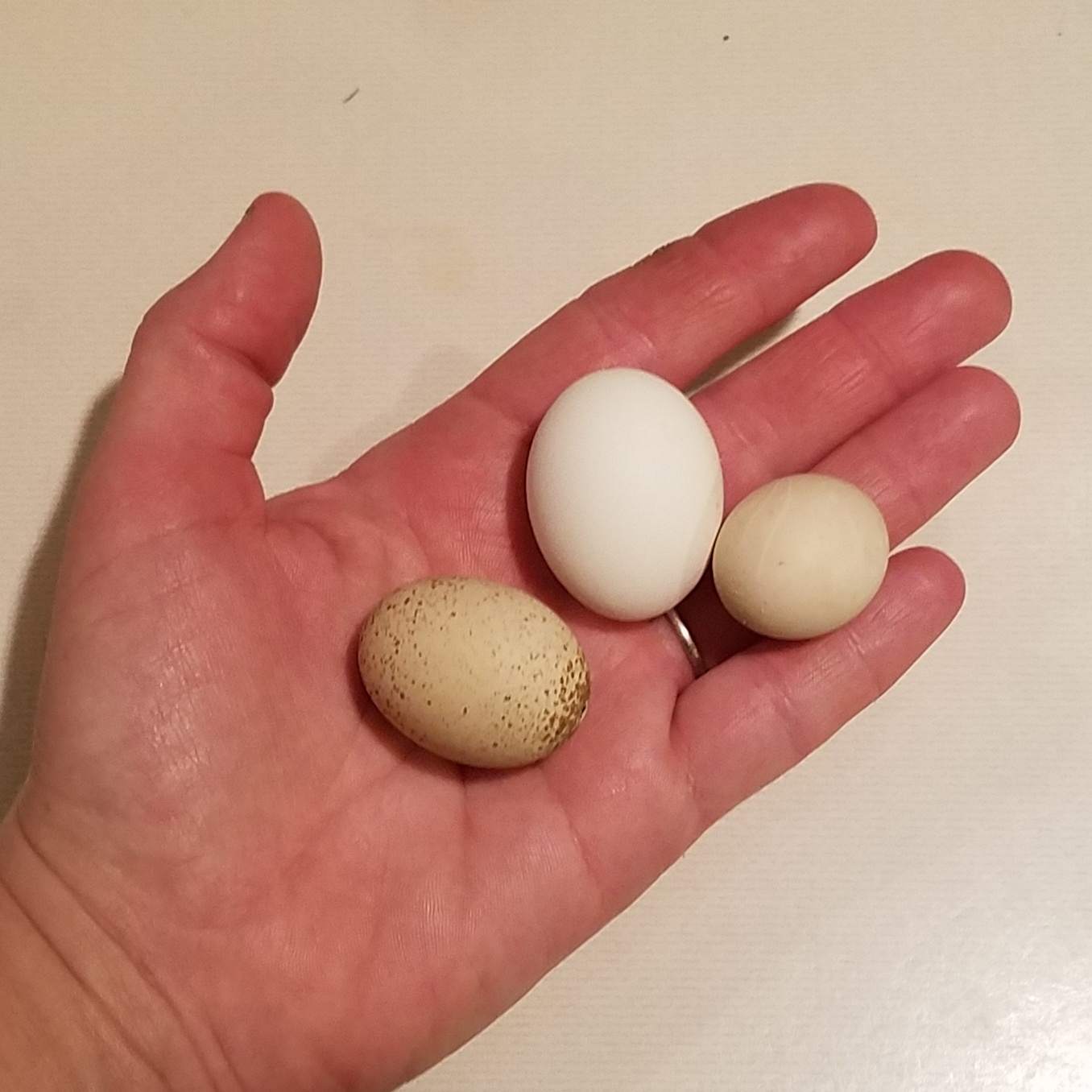
Sometimes a hen will lay a tiny egg (here are 3 that I’ve emptied and saved).
These eggs usually have no yolks are often called wind (or fart) eggs, dwarf eggs or rooster eggs. Many times an egg without a yolk is one of the hen’s first eggs, laid before her system is working properly. These eggs also occur when a piece of tissue breaks away from the hen’s reproductive tract and is treated like a yolk as it travels through the oviduct. When this is the case, a small piece of greyish tissue can usually be seen in the albumen.
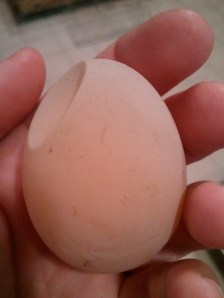
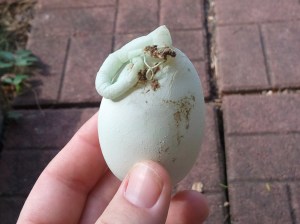
Egg with a “Tail”
This egg was such a surprise. The shell was hard like a normal shell everywhere, except “tail” and where the “tail” met the egg. That part of the shell wasn’t hard but it wasn’t quite as soft as the membrane of the shell-less egg above, though. It is thought to be caused by the egg not being hardened enough before being laid. The soft part of the shell is then elongated as the egg is being passed.
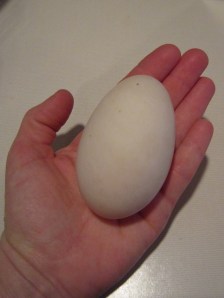
Double Yolk Eggs
Double-yolk eggs occur when 2 yolks are released at the same time, or when they are released close enough together that they become encased in the same membrane and shell. These eggs can occur at the beginning of a hen’s laying cycle, but some hens are genetically predisposed to lay double yolk eggs on a regular basis. (It’s similar to fraternal twins running in families.) In hens that lay these eggs only occasionally, the egg laying cycle is usually interrupted. Hens generally lay an egg every 24-36 hours but if they skip a day, the next egg that they lay can be a double-yolk egg. These eggs rarely hatch 2 chicks if incubated. Multiple factors are at play: each yolk may not be fertilised and if they both are, both chicks may not survive pipping without careful assistance. Below is a double-yolk duck egg:
I am sitting here going through sections of our website, and I come to my blog drafts page. Imagine my surprise to find this post that I thought I had published in 2014!
Enjoy these lamb pics while we wait patiently until April when this year’s lambs will be born.
~~~~~~~~~~~~~~~
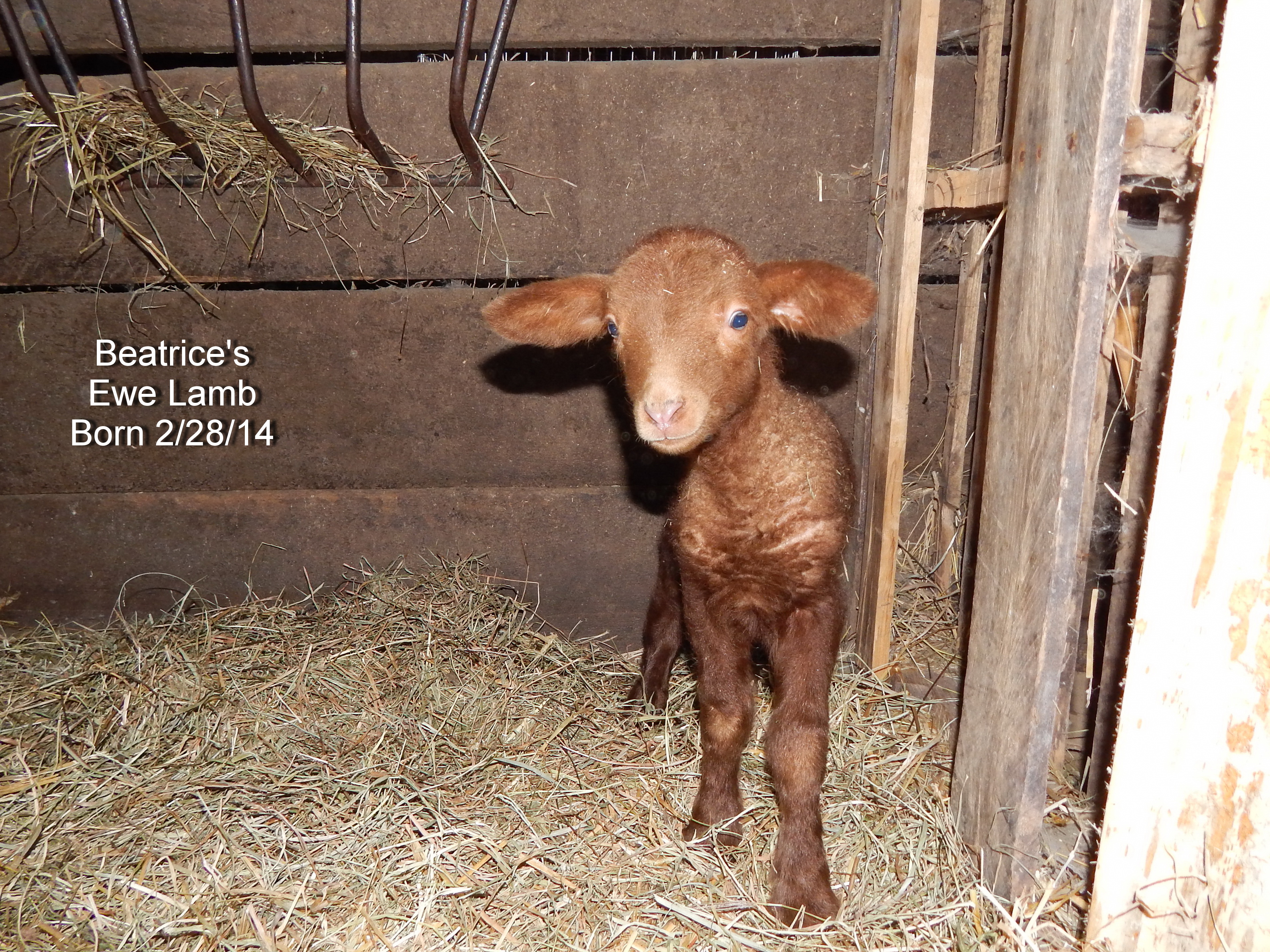
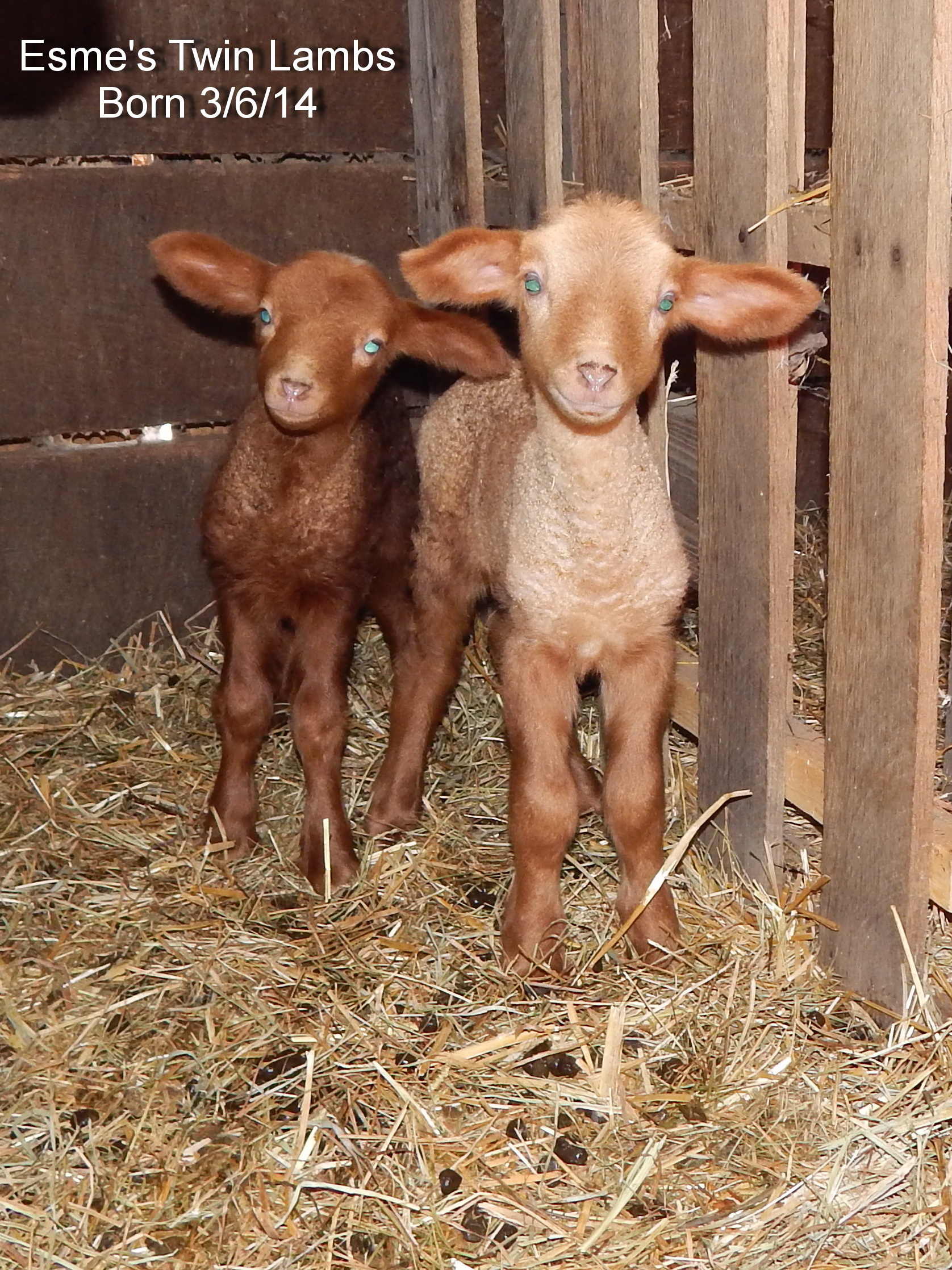
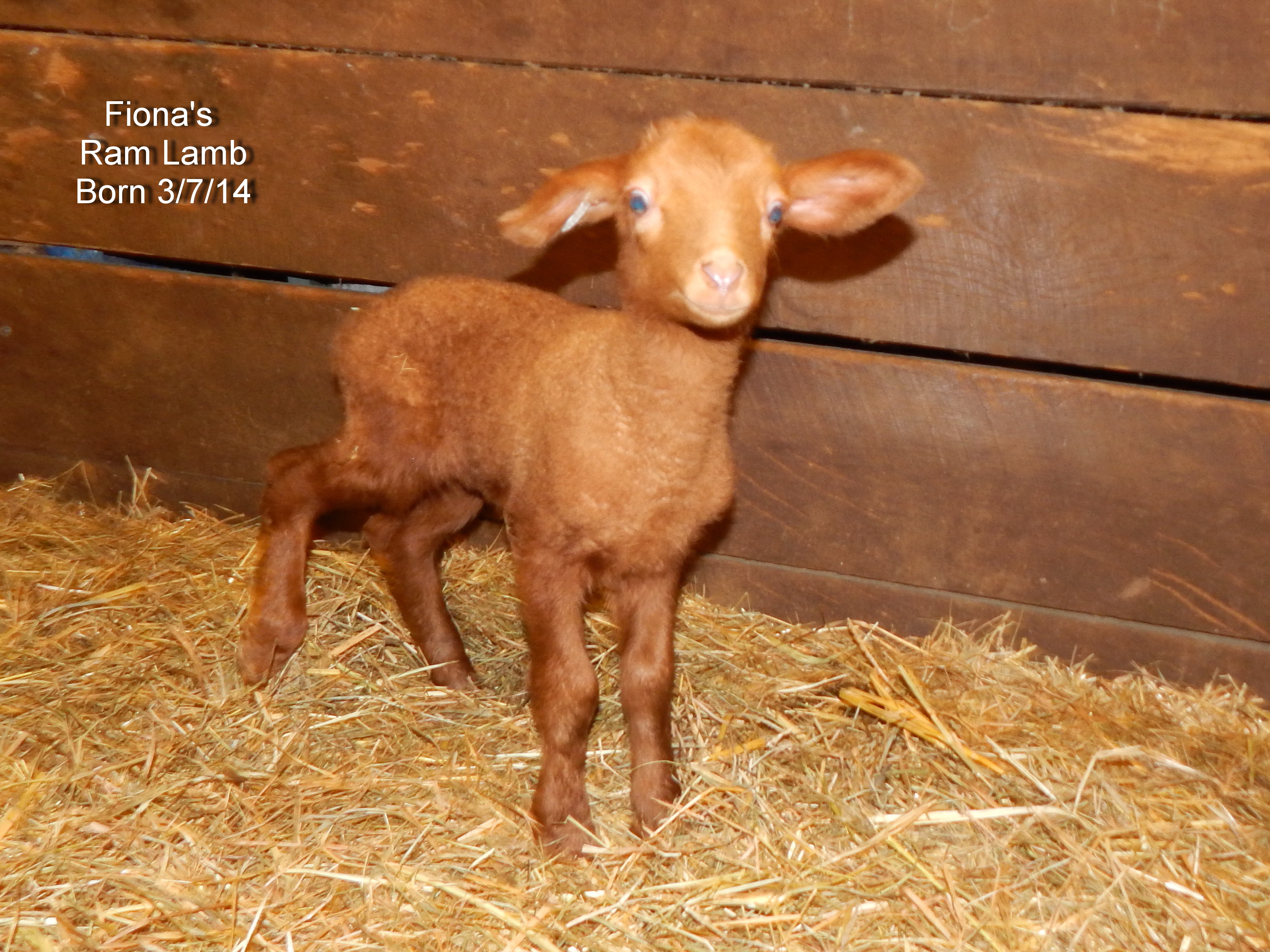
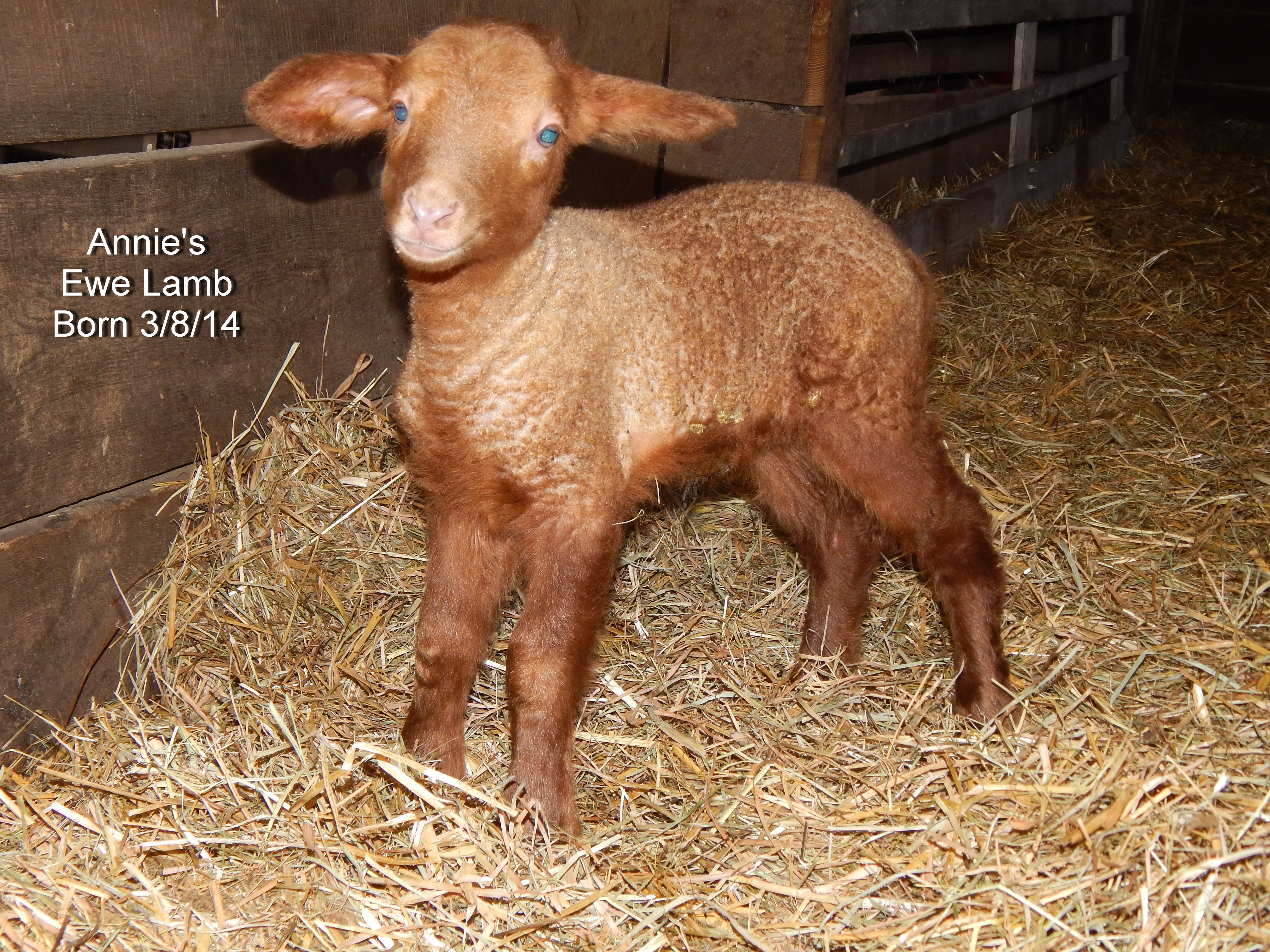
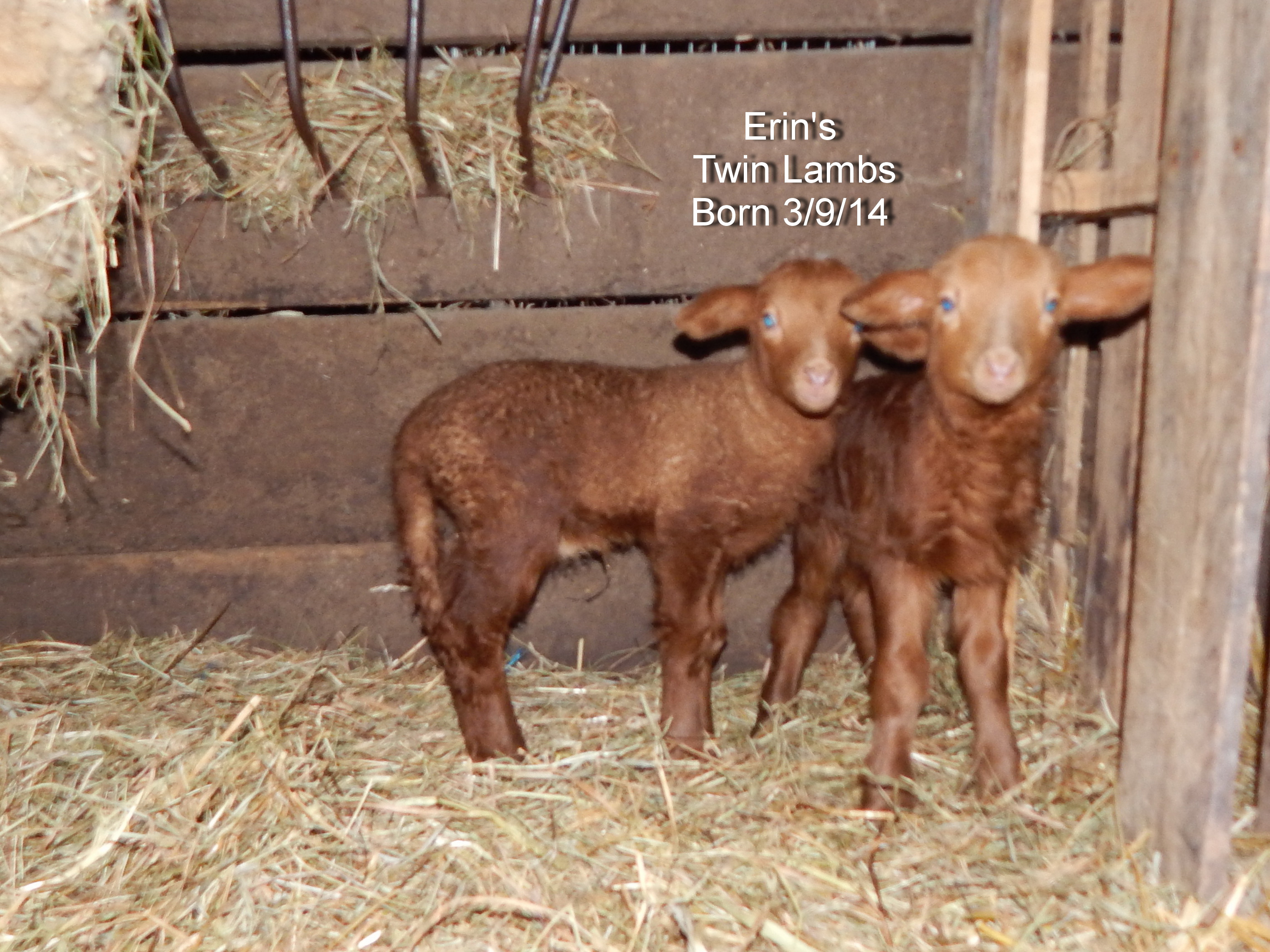
In 2014 we were blessed with 10 healthy lambs! 6 ewe lambs and 4 ram lambs; 3 sets of twins and 4 singles. Our lambing season began on February 28th and lasted till March 9th (when we had 2 sets of twins born).
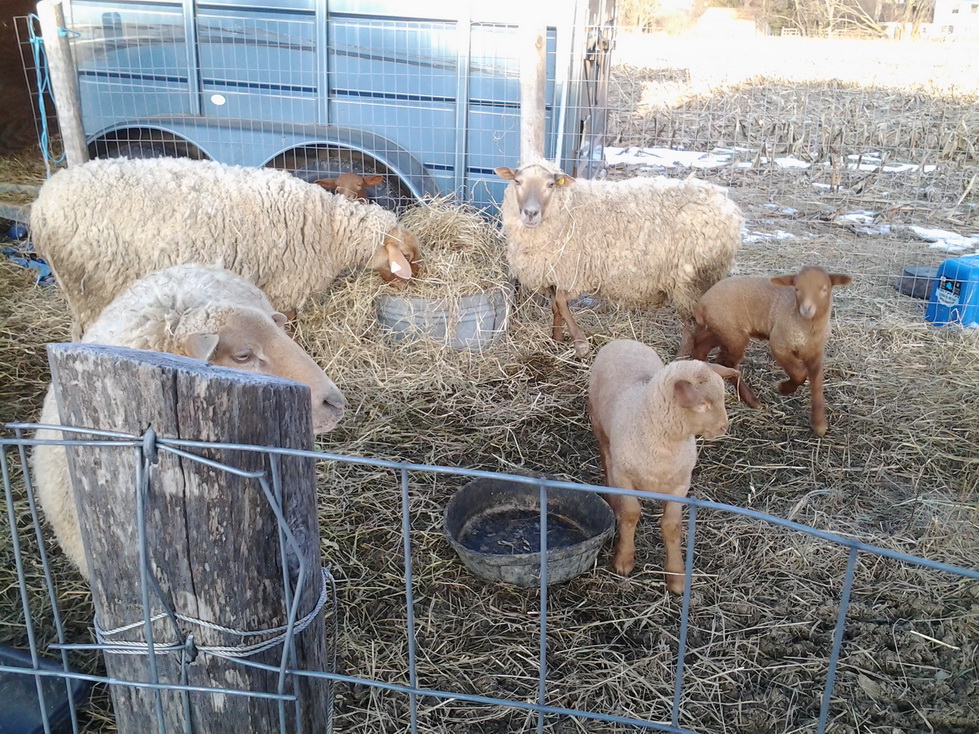
Because of the extreme cold weather that winter and the icy conditions we kept the ewes and lambs in the barn until the ice melted and the youngest lambs were a couple weeks old.
It was great to watch them enjoy their new-found freedom when we finally were able to bring them outside.
They had been outside for a couple weeks and were racing a few times every day. I don’t think I’ll ever get tired of watching them!
We brought Camille and her 2-week old ram lamb home in May 2009. After weaning, we sold Camille’s lamb “Cameron” to Christine E. in NJ to be the herdsire for her flock. He produced beautiful offspring, but in 2012 Christine decided not to breed her sheep. It turns out Cameron had other ideas…
~~~~~~
Here’s Christine’s story:
We had Cameron and 13 ewes. We decided not to breed, so in May 2012 we separated Cameron from the ewes in a connecting pasture separated by 4×4 mesh sheep fence. On January 16, 2013, I noticed that one of the two-year old ewes was bagging up. We were not set-up for lambing (had disassembled lambing pens), so we put her in my horse trailer. Within 48 hours, she delivered 2 lambs.
After that, I got down on my knees to study all of the ewes as they walked around in the pasture. The ewes were of course very woolly, so it was difficult to tell for sure as they all looked fat and the only way to really get an idea if they were pregnant was to see if they were bagging up. As they are on 5 acres, it was impossible to catch each one to get a hands-on check of them.
I noticed another ewe bagged up, brought her to the horse trailer, and she had a lamb.
I thought that was it. 2 days later, I went out to the pasture to feed, and I noticed all of the sheep were laying outside of the shelter even though it was windy. It made me suspicious, so instead of just throwing hay over the fence, I went inside and walked to the shelter. There was a ewe and a lamb. All of the sheep stayed outside (I’m guessing) to make sure they didn’t step on the lamb. My horse trailer was not safe for any more ewes, so we put her in my old chicken coop.
I then noticed that my 11-year-old ewe was bagging up and even though she was fat around her stomach, I could feel her spine and ribs. I brought her up to the coop so I could grain her. About two weeks later, she had twins.
Another ewe was bagging up. I had to put her in the horse trailer because we were running out of room in the coop. We set up an outside pen so the sheep could go in and out of the trailer. That ewe had a lamb but it was weak and I was afraid to leave it in with so many sheep (afraid it would get trampled), so we made it a bottle baby.
It was snowing one morning, and I went out to the sheep pasture, and found a lamb laying in the snow with mama nowhere to be found. My second bottle baby.
In total, we had 8 lambs born to 6 ewes. One of the first set of twins died because the mother rejected him. I kept him in with the mother, holding her and forcing her to let him nurse and supplementing him with a bottle. One morning, I found him dead. It looked like his neck was broken. Either his mother or the other ewe must have stepped on him or shoved him against the wall when he tried to nurse. He was almost 2 weeks old, so it was very sad.
The first lambs were born on January 18 and the last on February 11.
Besides losing the one lamb, my only regret is that I didn’t get to see Cameron breeding the ewes through the fence!
~~~~~~
I’ve heard of rams breeding ewes through a fence… but this is the first time I heard of one breeding 6 ewes through a fence! Now I know why some breeders have “Abstinence Alleys” (space between fences so sheep cannot have direct contact)! I am so thankful to Christine for letting me share her story. I hope she doesn’t mind how long it’s taken me to post it!









 Red Rope Farm